
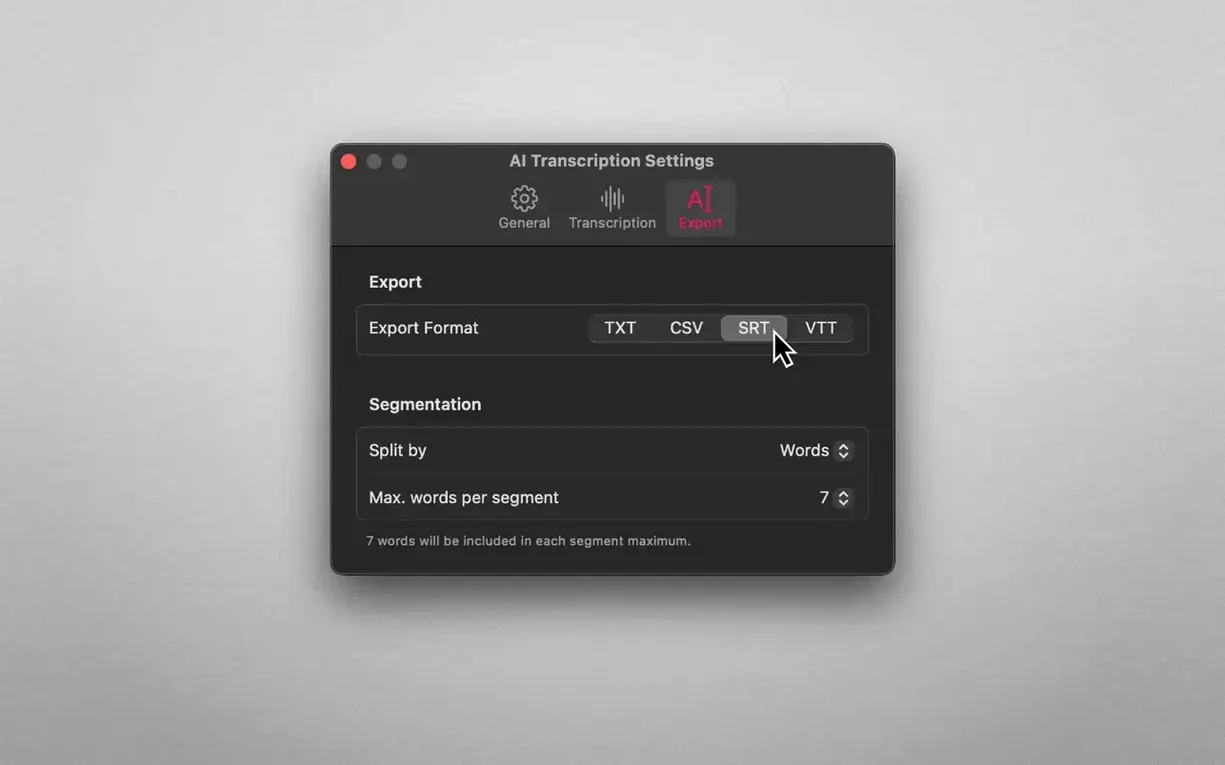
People who record meetings, interviews, or voice memos and hate the idea of their audio bouncing around some cloud server tend to gravitate toward this one. It's built for folks who want a transcript without an internet connection, which turns out to be a fair number of lawyers, journalists, and anyone who signs NDAs regularly.
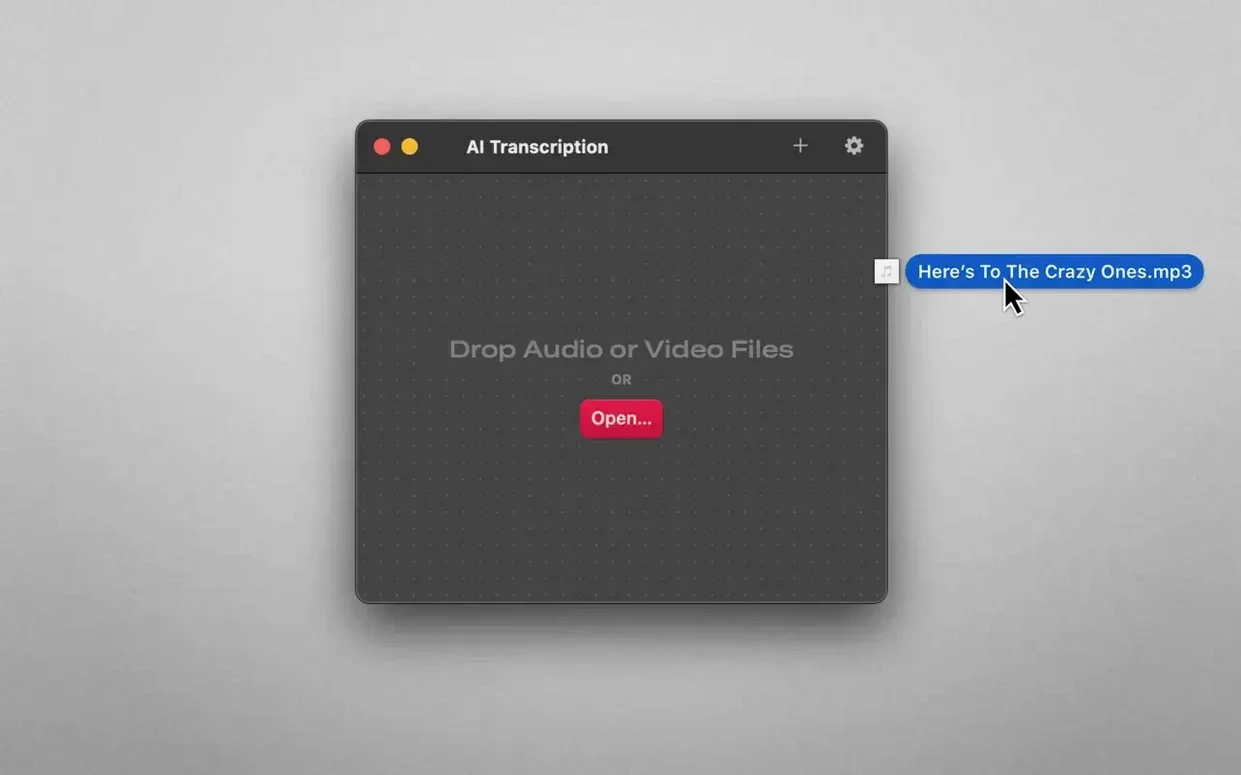
You drag an audio or video file onto the window — MP3, WAV, M4A, MP4, the usual suspects — and choose between two brains. Apple's built-in speech recognition is fast and fine for clean recordings. OpenAI Whisper takes a bit longer but handles accents and imperfect audio better. Either way, the work stays on your Mac. The app runs on Intel and Apple Silicon machines with macOS 14.6 or later.
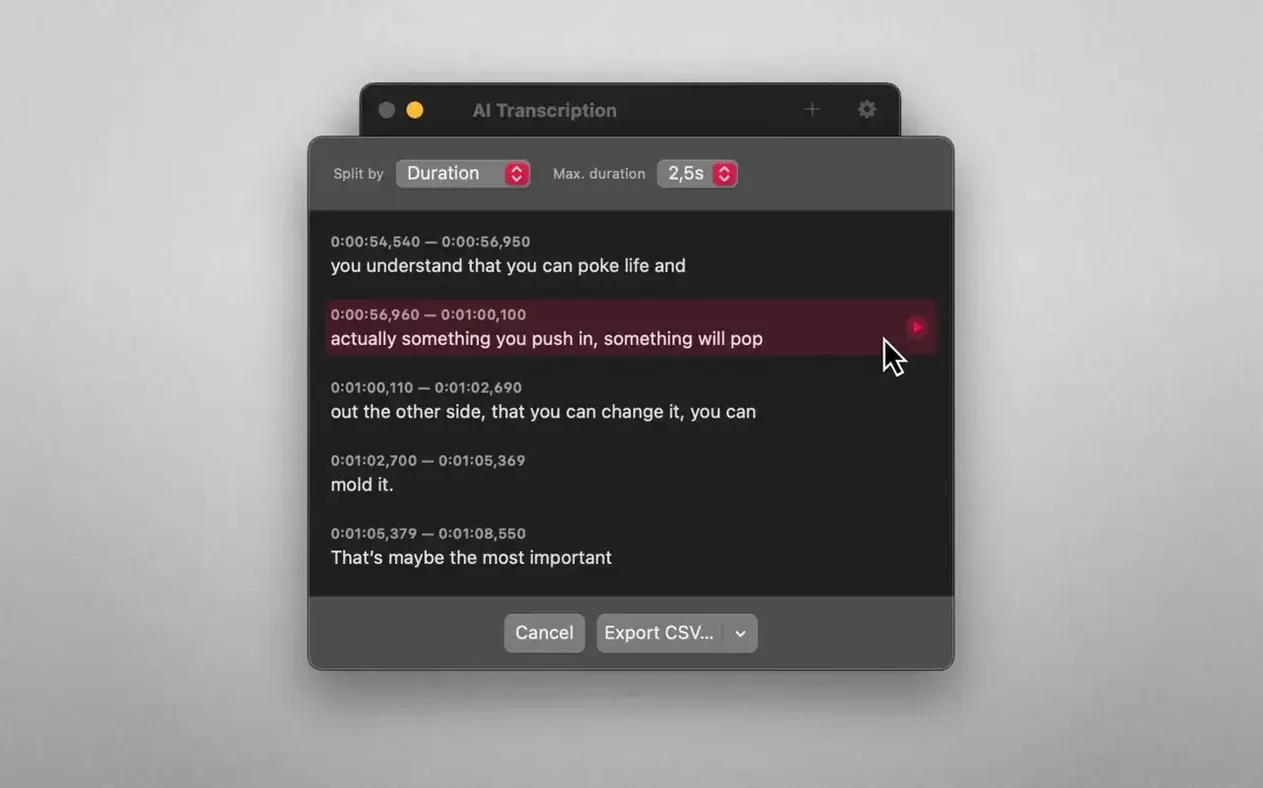
The transcript comes out split by words, sentences, or chunks of time. I tend to leave it on sentence mode because reading a wall of timed segments gives me a headache. From there you copy it out and clean it up in whatever you write in.
Bottom line: a blunt, private transcription tool that doesn't try to be a note-taking suite. Drop in a file, pick an engine, get text back. That's the deal.
Fit and finish you feel after a week
Version 2.16 didn't reinvent the app, and that's a good thing. The developer spent the cycle on fit and finish — the kind of stuff you notice after living with the app for a week, not after a five-minute test drive.
- The Whisper engine got a speed bump on Apple Silicon Macs. A forty-minute interview that used to take three minutes now clocks closer to two. Small difference on paper, but when you're transcribing five files back to back, it adds up.
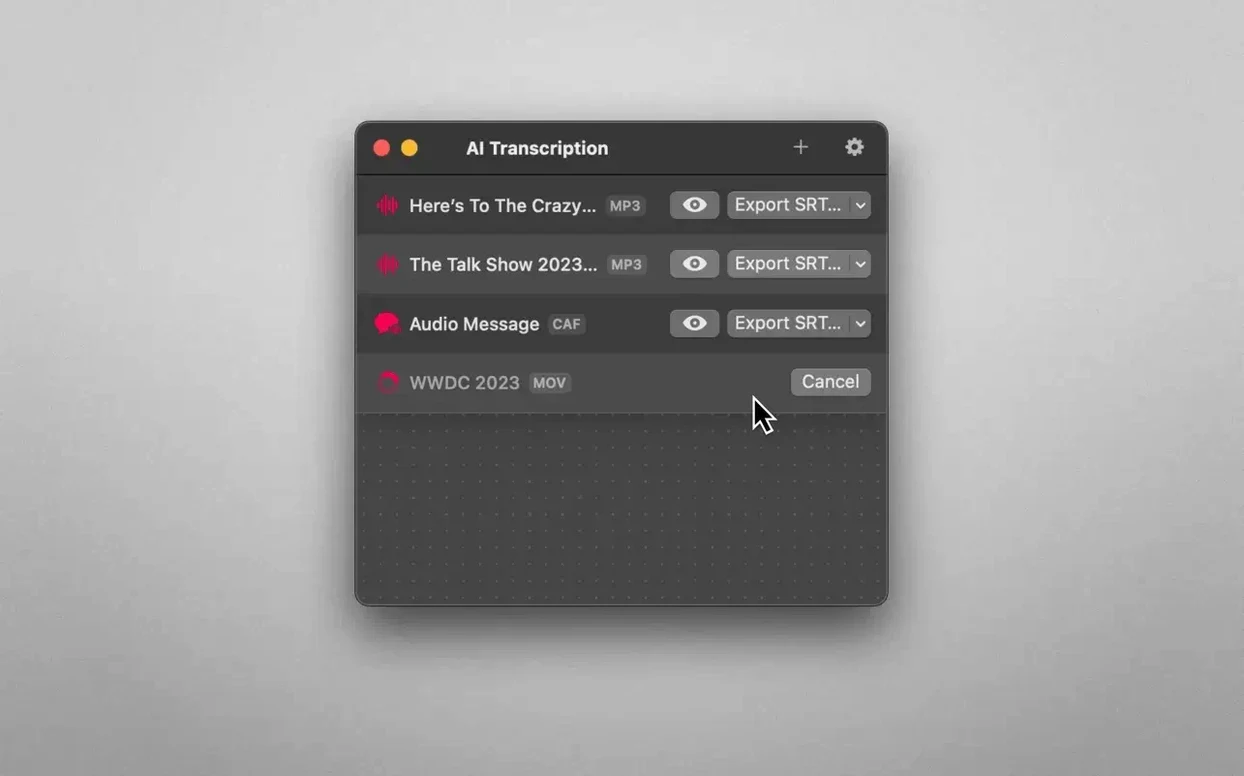
- Speaker labels stopped drifting. Earlier versions occasionally lost track of who was talking after a long pause. 2.16 tightened that up. If you transcribe panel discussions or multi-person podcasts, the SRT exports are cleaner now.
- Language switching got sticky. The app remembers your last language choice per file, so you're not re-selecting Spanish every time you drop in a bilingual recording.
Most of these fixes came from user feedback, not marketing roadmaps. The ai transcription 2.13 and 2.14 releases focused on the Whisper integration — before that, the app leaned harder on Apple's engine. By ai transcription 2.15, the offline workflow felt settled. Version 2.16 is essentially the tidy-up release.
Local-only transcription, without the upsell push
Three names come up when people ask about Mac transcription that doesn't phone home.
MacWhisper also wraps OpenAI Whisper and runs locally. The difference is focus: MacWhisper pushes its paid tiers with batch processing and speaker diarization. AI Transcription keeps it simpler — one view, two engines, no feature gates. If you want a tool that feels like a kitchen appliance, this is the one.
Otter.ai is the opposite of offline. It's a full collaboration platform, and everything goes through its servers. Great for teams who need shared notebooks and searchable archives. Terrible for a lawyer who can't let client audio leave the building.
Dictation.io works in a browser and costs nothing. But it's live transcription only — no file uploads, no Whisper, and your audio streams to a web service. Fine for quick notes. Not in the same category for serious work.
Bottom line: AI Transcription sits in a narrow lane — offline, file-based, two engines, no fuss. MacWhisper offers more features for a price. Otter and Dictation.io trade privacy for convenience. Pick based on what you actually need.
- macOS 14.6 or newer
- Apple Silicon or Intel 64-bit Mac
Questions I actually get
Does the audio ever leave my Mac?
No. Transcription runs entirely offline using Apple Speech Recognition or OpenAI Whisper on your own machine.
Notes from the tables 0
Sign in or pull up a chair to leave a note.
No notes on this one yet. They go up after I read them.
More from the AI Tools page
The whole page AI Tools Updated 322 MB
Luminar AI
1.5.5
AI Tools Updated 322 MB
Luminar AI
1.5.5
 AI Tools 1.8 GB
MacGPT
3.21
AI Tools 1.8 GB
MacGPT
3.21
 AI Tools 9 MB
MacWhisper
15.3
AI Tools 9 MB
MacWhisper
15.3
 AI Tools Updated 75 MB
superwhisper
2.18.5
AI Tools Updated 75 MB
superwhisper
2.18.5
 AI Tools Updated 43 MB
Topaz Gigapixel AI
1.3.5
AI Tools Updated 43 MB
Topaz Gigapixel AI
1.3.5
 AI Tools 372 MB
Topaz Photo AI
2.1
AI Tools 372 MB
Topaz Photo AI
2.1
 AI Tools Updated 36 MB
VideoProc Converter AI
8.12
AI Tools Updated 36 MB
VideoProc Converter AI
8.12
 AI Tools 254 MB