

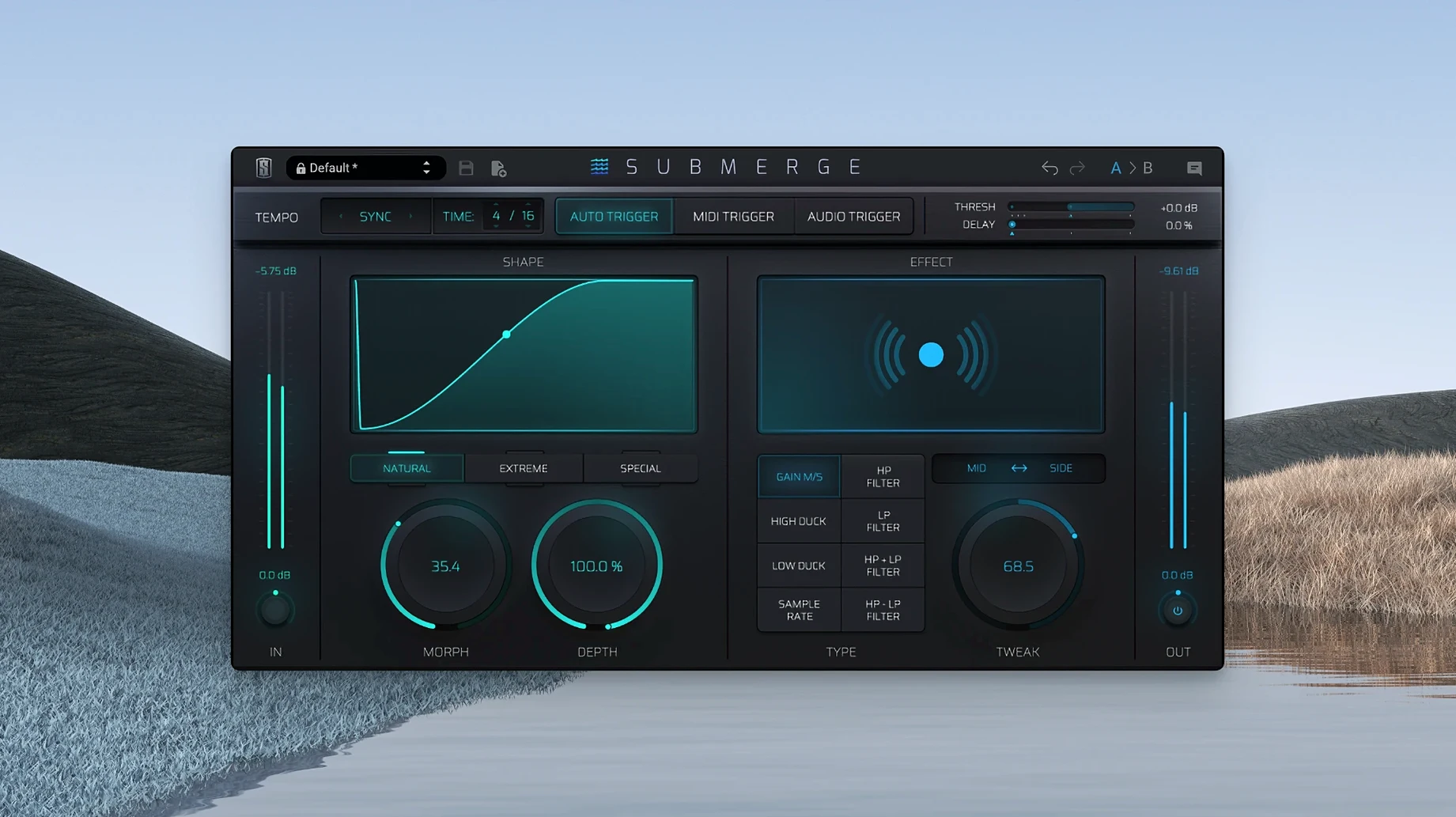
Version 1.0.5 is a maintenance release that keeps Submerge running smoothly on Apple Silicon Macs, so the focus stays where it belongs — on what the plug-in does to a track. It triggers an automatic sidechain with a handful of controls that feel like they were laid out by someone who mixes, not someone who just writes code.
| What | The details |
|---|---|
| Type | Automatic sidechain plug-in |
| Controls | Threshold, Speed, Morph, Depth, Tweak |
| Effects | Eight built-in, plus high-pass and low-pass filtering |
| Trigger modes | Auto (tempo-synced) or external audio signal |
The Morph knob is the heart of it — it sweeps through the eight onboard effects, reshaping the ducking character from tight and clinical to something that breathes. Depth sets how far the signal dips, Speed tightens or loosens the envelope, and Threshold decides when the whole thing kicks in. Tweak is the fine-adjustment lane, nudging the onset so the pocket sits right. High-pass and low-pass filters let you confine the effect to the part of the frequency spectrum that actually needs to move, which keeps the low end clean when you only want the hats to duck. Hold Shift and the curve flips — ducking turns into pushing, useful for emphasizing a transient instead of burying it. In Auto mode the plug-in locks to project tempo; feed it an external signal and the kick drum calls the shots directly. Bottom line: Submerge is a focused tool that does one job without overcomplicating it.
Slate Digital isn't the only name in the auto-ducking lane, so here's how Submerge sits alongside a couple of familiar alternatives on the Mac. Xfer LFO Tool is a long-time favorite for programmed pumping — you draw the curve, set the rate, and it runs. It does not listen to an external audio signal, though, so if you want your bass to duck only when the kick hits, you're back to drawing shapes and hoping the timing holds. Submerge replaces that guesswork with the audio trigger mode, which follows the actual kick performance. Cableguys VolumeShaper has more curve editors, multiband options, and envelope followers, but that flexibility comes with a screen full of nodes and waveform windows. Submerge keeps the decision count low — a few knobs, a handful of built-in effects, and the sound changes fast. If you spend your days designing elaborate volume envelopes, the Cableguys approach might call your name. If you want the kick to push the bass out of the way in three clicks, Submerge is the more direct path.
When audio trigger mode stays silent
A common head-scratcher happens when the plug-in seems to do nothing in audio trigger mode. The fix is almost always the sidechain routing inside your DAW — Submerge needs an actual signal assigned to the sidechain input, and different DAWs bury that assignment in different menus. In Logic Pro, for instance, you set it from the plug-in window's sidechain dropdown, not from a send. Once a signal is assigned, the Threshold knob should start lighting up with input activity.
Another bump people hit is tempo drift in Auto mode. The plug-in follows the host tempo, but if your DAW's transport is paused and you're auditioning a loop, some hosts stop sending tempo information. Hitting play usually snaps it back in sync. If the pumping feels sluggish even at fast Speed settings, check whether a high-pass filter is cutting too much of the trigger information — the plug-in reacts to what it hears, and a heavily filtered signal might not provide enough envelope detail.
When the Shift-invert trick turns ducking into pushing but the result sounds thin, try narrowing the effect to the mid or side channel. Mid/Side processing can keep the push focused on the center image while leaving the stereo information alone, which often cleans up a messy transient boost. If you're working with a slate digital crack mac setup and something still feels off, verify the installer version matches the build — 1.0.5 was compiled for Apple Silicon, and a mismatched installer pulled from a slate digital mac torrent occasionally drags in an older Intel binary that Rosetta has to translate.
Last thing — the Morph knob doesn't preview effect names as you turn it. The eight effects blend under the hood, so your ears are the only guide. If one setting sounds too aggressive, back Depth off a few ticks before you blame the effect itself. Sometimes the difference between usable and overdone is a millimeter on that Depth dial.
- macOS 11 or later
- Apple Silicon processor
Questions I actually get
Can Submerge respond to an external audio source?
Yes, the audio trigger mode lets an external signal — like a kick drum — control the ducking or pumping effect in real time.
What happens when I hold Shift in Submerge?
Holding Shift inverts the curve, flipping the effect from ducking into pushing so the signal gets louder instead of quieter.
Notes from the tables 0
Sign in or pull up a chair to leave a note.
No notes on this one yet. They go up after I read them.
More from the VST Plugins page
The whole page VST Plugins 69 MB
Slate Digital Murda Melodies
1.1.1
VST Plugins 69 MB
Slate Digital Murda Melodies
1.1.1
 VST Plugins 179 MB
Slate Digital Fresh Air
1.0.9
VST Plugins 179 MB
Slate Digital Fresh Air
1.0.9
 VST Plugins 40 MB
Sonic Academy KICK
1.1.8
VST Plugins 40 MB
Sonic Academy KICK
1.1.8
 VST Plugins Updated 358 MB
ShaperBox
3.6.1
VST Plugins Updated 358 MB
ShaperBox
3.6.1
 VST Plugins 111 MB
Spire
1.5.19
VST Plugins 111 MB
Spire
1.5.19
 VST Plugins 158 MB
Serum
2.0.24
VST Plugins 158 MB
Serum
2.0.24
 VST Plugins Updated 30 MB
Serato Sample
2.2.0
VST Plugins Updated 30 MB
Serato Sample
2.2.0
 VST Plugins 612 MB