
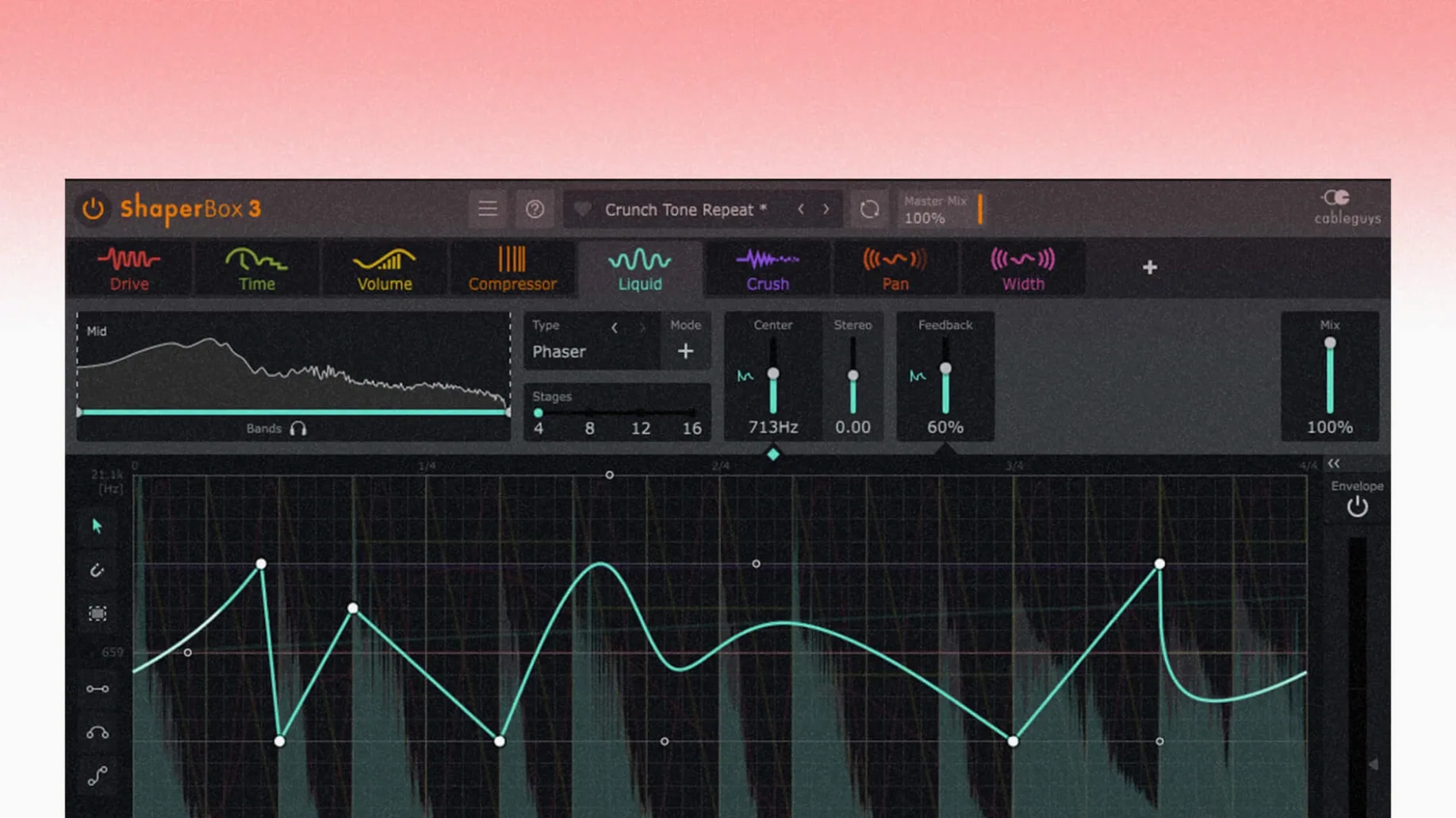
ShaperBox is a modular multi-effect that lets you apply rhythmic movement to any sound. It sits right alongside your usual EQs and compressors, but handles the time-based trickery they leave on the table.
- Pick your band. Split the signal into low, mid, and high sections so the bass ducks independently from the vocal sizzle.
- Choose a module. Stack Shaper effects like Volume, Pan, or the new PitchShaper on each band. They all stay sample-accurate with your session.
- Set a trigger. Enable Audio Trigger on any channel. Instead of fighting your kick drum, the effect moves with it.
- Shape the curve. Draw the modulation you want, not the one a preset decides for you.
The workflow feels like cooking with a trusted pan—nothing flashy, just the tool that gets the job done right. Version 3.6.1 cleaned up a Logic Pro cursor glitch and a rare artifact that could pop up when a MIDI note arrived during silence. Now PitchShaper's Formant Link, Density, and Grain Size are all automation-ready, so your moves get recorded exactly as you perform them.
Little shortcuts that make a big difference
After a few hundred sessions with ShaperBox, your fingers learn where things hide. A couple of moves I wish I knew on day one:
- Hold Option while dragging a curve point and the movement locks to vertical or horizontal—cleaner than nudging a fader with your mouse three times and hoping for the best.
- Right-click any preset in the browser to audition it without loading. The browser keeps playing your track while you flip through candidates, which beats opening a menu, hearing a sound, closing the menu, opening another one, and forgetting what the first one sounded like.
- Double-click a band's solo button to hear exactly what that band is catching. When you're setting crossover points on a muddy synth bus, this clears things up faster than any spectrum analyzer.
- The Audio Trigger sidechain display isn't just for show. Click and drag the waveform to shift the trigger timing earlier or later by milliseconds. Useful when your kick hits slightly ahead of the grid and the ducking feels off.
These aren't the things you'll see in a tutorial video, but they're the moves that keep a session flowing when you're deep in it.
Day one: grab a drum loop and load the first preset
ShaperBox comes with 600 presets, and loading a preset feels like borrowing someone else's pedalboard. That's a fine way to start, but here's where you should spend your early hours once the novelty wears off.
Day one: Grab a drum loop and slap VolumeShaper on it. Switch the timing to triplet mode and draw a simple ramp-up curve over one beat. You'll hear the loop breathe in a way a compressor never quite manages. Then turn on Audio Trigger and route your kick into the sidechain—now the breathing follows the kick rather than a static grid. That's the difference between a plugin that sounds cool and one that locks into your track.
Day two: Open LiquidShaper on a vocal and resist the urge to drown it. Set the mix to about 25%, pick a slow flanger curve, and listen to what happens when the effect moves around the vocal instead of sitting on top of it. Most flangers sound like a jet plane taking off. This one can sound like a room shifting its shape.
Day three: Explore the multiband side properly. Load PanShaper on the high band only, draw a ping-pong curve, and leave the low band dead center. Your hi-hats dance left to right while the kick stays planted. It's a stereo trick that doesn't collapse in mono, and it takes thirty seconds to set up.
If you've grabbed a shaperbox 2 download or a shaperbox torrent in the past and only scratched the surface, the jump to version 3 gives you PitchShaper and multiband routing that older builds didn't have. A shaperbox mac crack running an outdated version still gets you the core experience, though you'll want to check which build you're on. Even a shaperbox 3 mac torrent from a few months back won't include the 3.6.1 automation fixes—and once you start automating PitchShaper's formant shifts in real time, you won't want to go back.
A Tuesday afternoon, a static chorus, and a bass that needs to move
Let me walk you through a typical half-hour with ShaperBox on a Tuesday afternoon. Nothing staged—just how it goes when a mix needs something to move.
I pull up a track that's nearly there. The chorus feels static. The bass and the kick are stepping on each other, and the synth pad sits like a blanket over everything. I drop ShaperBox on the bass channel first.
VolumeShaper loads by default. I set the crossover points so the low band covers 20 to 120 Hz, right where the kick lives. Audio Trigger goes on, listening to the kick track. I don't draw a curve yet—I just watch the sidechain display pulse in time with the kick hits. That tells me the trigger is catching cleanly. Then I drag the waveform slightly left, about 4 milliseconds, so the ducking starts just before the transient lands. The kick punches through without the bass disappearing too early.
Next, I add PitchShaper to the mid band of the synth pad. I'm not after a dramatic pitch dive—I set the range to a semitone and draw a gentle downward curve that resets every quarter note. The pad now dips subtly on each beat, almost like a player bending a string. Density gets pulled back a touch so the effect sounds more like tape warble than a digital shift. The Grain Size stays short, keeping the transients tight. Since 3.6.1, I can automate the Formant Link parameter too, so later I'll ride it up during the bridge for a vocal-like lift without touching an EQ.
Finally, PanShaper on the high band of a percussion bus. Straight timing, narrow pan spread, just enough to give the shakers a gentle sway. Nothing calls attention to itself. The whole thing took twenty minutes, and the track now breathes without a single automation lane drawn in the DAW—ShaperBox handles the movement internally, sample-accurate and locked to tempo.
I save the patch, name it something I'll actually recognize later, and move on. That's the session. No magic, just a tool that does what you tell it.
Version 3.6.1 is a maintenance update with a couple of workflow improvements. PitchShaper's Formant Link, Density, and Grain Size are now automation parameters, so you can perform those changes in real time. Two bugs are gone: an audio artifact that could sneak in when a MIDI note or Audio Trigger fired during silence, and a Logic Pro issue where the mouse cursor vanished after dragging a control.
- macOS 10.15 or later
- Apple Silicon or Intel 64-bit processor
Questions I actually get
Can I process different frequency ranges separately?
Yes, ShaperBox supports multiband processing so you can apply effects independently to the low, mid, and high frequencies of your audio.
Does ShaperBox run natively on Apple Silicon Macs?
Yes, version 3.6.1 supports both Apple Silicon and Intel 64-bit systems on macOS 10.15 and later.
Notes from the tables 0
Sign in or pull up a chair to leave a note.
No notes on this one yet. They go up after I read them.
More from the VST Plugins page
The whole page VST Plugins Updated 30 MB
Serato Sample
2.2.0
VST Plugins Updated 30 MB
Serato Sample
2.2.0
 VST Plugins 612 MB
Serato Hex FX
1.2.0
VST Plugins 612 MB
Serato Hex FX
1.2.0
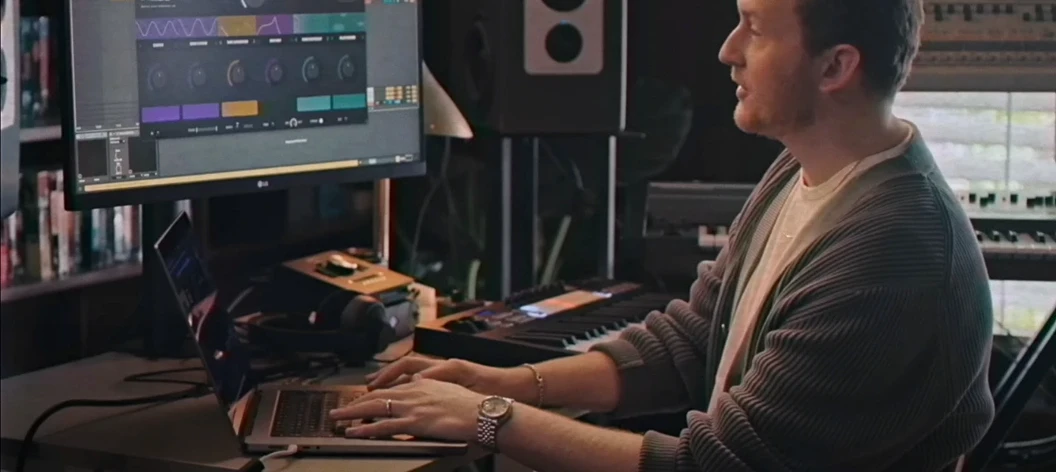 VST Plugins 105 MB
Slate Digital Fresh Air
1.0.9
VST Plugins 105 MB
Slate Digital Fresh Air
1.0.9
 VST Plugins 40 MB
Slate Digital Murda Melodies
1.1.1
VST Plugins 40 MB
Slate Digital Murda Melodies
1.1.1
 VST Plugins 179 MB
Slate Digital Storch Filter
1.0.6
VST Plugins 179 MB
Slate Digital Storch Filter
1.0.6
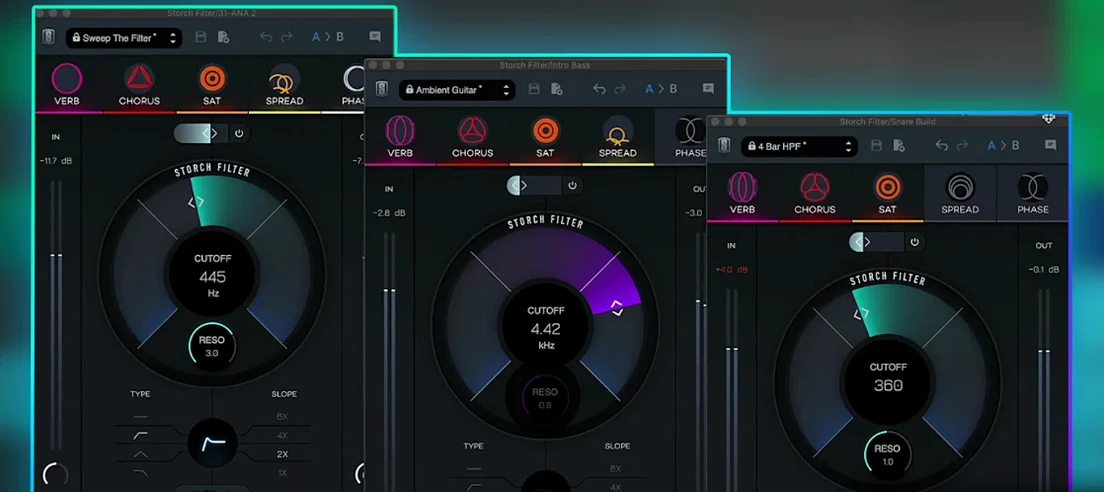 VST Plugins 69 MB
Slate Digital Submerge
1.0.5
VST Plugins 69 MB
Slate Digital Submerge
1.0.5
 VST Plugins 38 MB
Scaler 3
3.3.2
VST Plugins 38 MB
Scaler 3
3.3.2
 VST Plugins 1.4 GB