
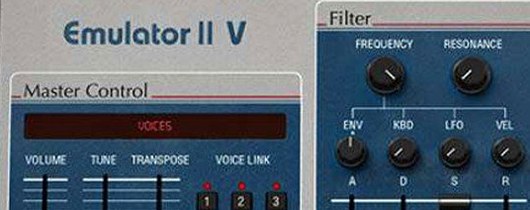
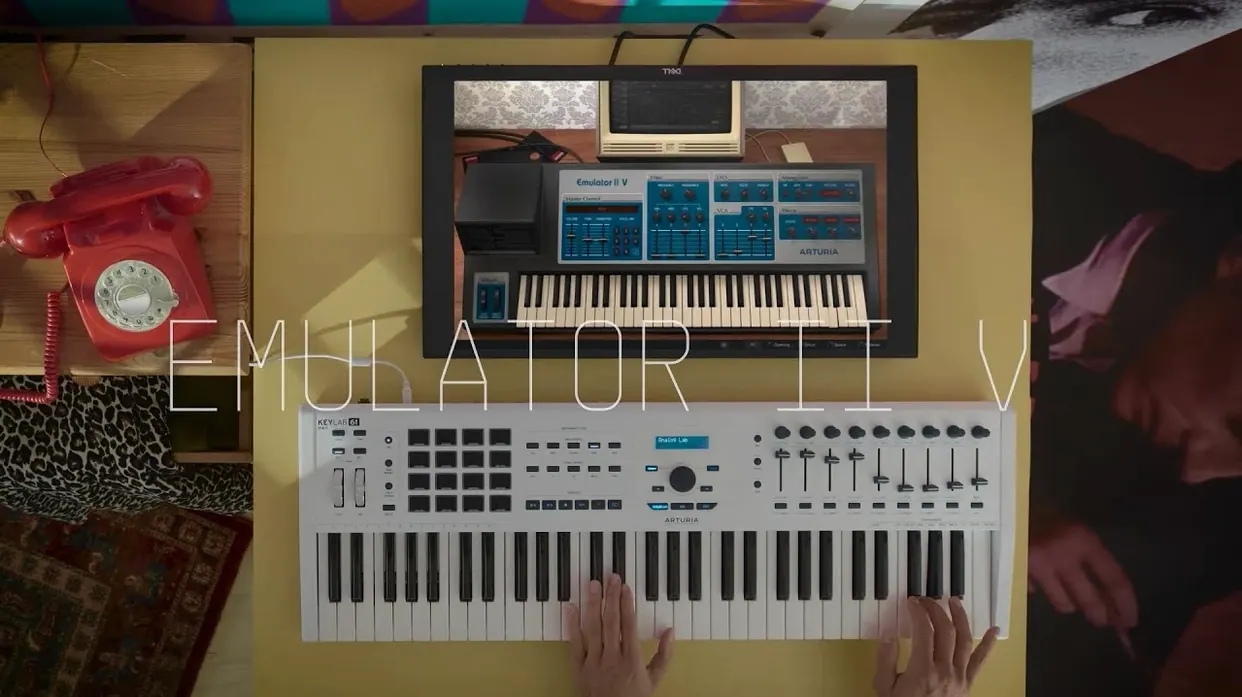
This one hasn't changed much under the hood in version 1.6.2 — it's still the same grimy, wonderful time machine Arturia released. I just want to make sure you can actually run the thing before you get excited about the sound.
Where it works
You'll need macOS 11 or later, and it runs natively on both Intel and Apple Silicon Macs — no Rosetta gymnastics required. The plug-in shows up in any DAW that hosts AU, VST3, or AAX formats. It also runs standalone if you just want to play without opening a session. Interface is in English only, and it's a 64-bit affair all the way.
Crusty 27.7 kHz character, expanded to 32 voices
The original E-Mu Emulator II ran at a crusty 27.7 kHz with 8-bit companding, and Arturia kept that character intact. You get 32-voice polyphony across 8 multitimbral parts, which is a lot more flexible than the hardware ever was. Each layer piles on its own VCF, ADSR, LFO, and a VCA with its own ADSR — so a flute can turn into a chattering bassline with a few tweaks. You also get the full 250 factory presets. Bottom line: it's the lo-fi sampler you'd find in a dusty road case, only it won't throw a boot error mid-set.
Modern sampler habits that backfire here
The Emulator II V rewards a little patience, but there are a few habits I see working against new users. None of them are the software's fault — they're mostly leftovers from how we think modern samplers should behave.
- Cleaning up the dirt. You load a preset, hear the hiss and the slightly wobbly top end, and reach for an EQ to "fix" it. That grit is the instrument. The 8-bit companding and 27.7 kHz rate are baked into the engine, so if you polish it away you're left with a plain digital synth that happens to have old sample names.
- Ignoring the per-layer envelopes. It's easy to treat each preset as a finished sound and just play it. But the ADSR on each layer's VCA and VCF is where the magic hides. A pad can become a percussive pluck just by shortening the attack on one layer.
- Forgetting the arpeggiator. Arturia added one, and it's easy to overlook because the original hardware never had it. Layering a slow arp under a held chord gives you movement without touching the DAW.
- Expecting modern sample management. You're not getting drag-and-drop keymapping like a current sampler. You work with the curated library and the instrument's own architecture, which is closer to how the original worked. It's a mindset shift, not a missing feature.
If you need a quick starting point for a search, plenty of folks look for arturia emulator ii v free download just to get a feel for the character before committing to it in a project.
Smoother on recent macOS, no engine changes
Nothing dramatic — this is a maintenance-level update. The core sound engine and feature set are where they've been for a while. In everyday use, version 1.6.2 (build 5305) mostly means smoother behavior on recent macOS releases and fewer surprises when you load it in a session. Arturia tends to use these point releases to keep instruments stable across macOS updates, especially on Apple Silicon. You won't notice a new knob or a different sound, and that's fine. A sampler that already sounds right doesn't need a new coat of paint every few months.
One producer, one afternoon
Picture someone who scores short documentaries — deadlines are tight, and the music has to feel like it came from a specific decade without sounding like a parody. They open the Emulator II V, pull up a choir preset, and drop the sample rate down to let the 8-bit character do its thing. A second layer gets a short, plucky attack on the VCA to add a rhythmic pulse. The arpeggiator runs underneath at a slow rate, just enough to keep the bed moving. By the time the picture lock arrives, they've built three cues from the same core patch, each one altered with different filter and envelope settings. No external processing, no hunting for the right plug-in chain. It's all inside the instrument, and the result sounds like it was pulled from a 1986 archive reel. Searches like arturia v collection mac torrent often start from this exact itch — wanting that old hardware flavor without tracking down a fragile, forty-year-old machine.
- macOS 11 or later
- Intel or Apple Silicon Mac (64-bit)
Questions I actually get
Does the Arturia Emulator II V include the original E-Mu presets?
Yes, it ships with the full set of 250 original factory presets from the hardware.
Notes from the tables 0
Sign in or pull up a chair to leave a note.
No notes on this one yet. They go up after I read them.
More from the VST Plugins page
The whole page VST Plugins 16.1 GB
Arturia Efx AMBIENT
1.0.0
VST Plugins 16.1 GB
Arturia Efx AMBIENT
1.0.0
 VST Plugins 285 MB
Arturia Mellotron V
1.9.3
VST Plugins 285 MB
Arturia Mellotron V
1.9.3
 VST Plugins 2.1 GB
Arturia Comp FET-76
1.7.1
VST Plugins 2.1 GB
Arturia Comp FET-76
1.7.1
 VST Plugins 450 MB
Arturia Pigments
7.0.1-6772
VST Plugins 450 MB
Arturia Pigments
7.0.1-6772
 VST Plugins 1.8 GB
Arturia Augmented Voices
2.0.2
VST Plugins 1.8 GB
Arturia Augmented Voices
2.0.2
 VST Plugins 4.8 GB
Arturia Analog Lab V
5.12.0
VST Plugins 4.8 GB
Arturia Analog Lab V
5.12.0
 VST Plugins 4.4 GB
Arturia Acid V
1.1.5
VST Plugins 4.4 GB
Arturia Acid V
1.1.5
 VST Plugins 542 MB