
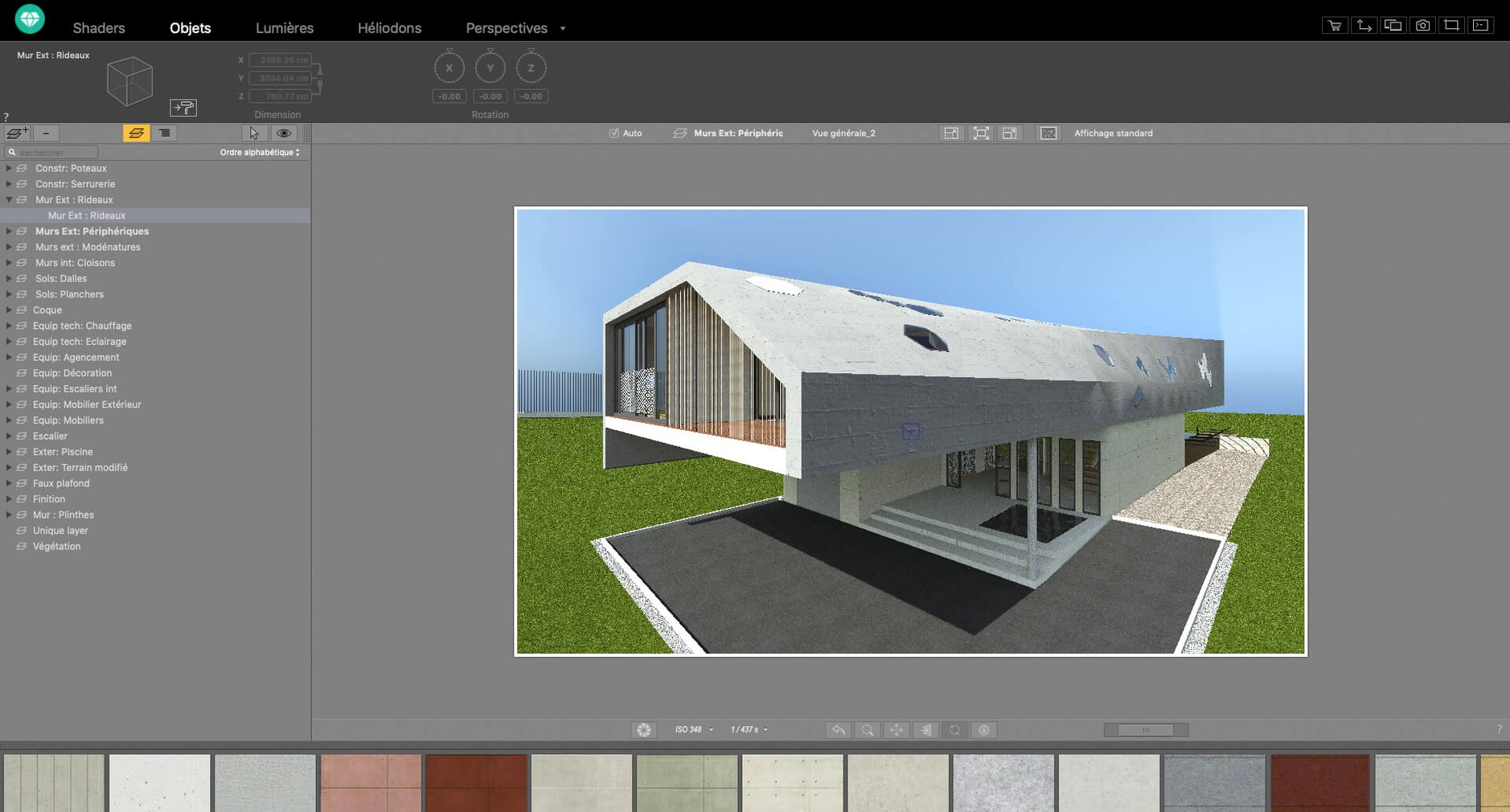
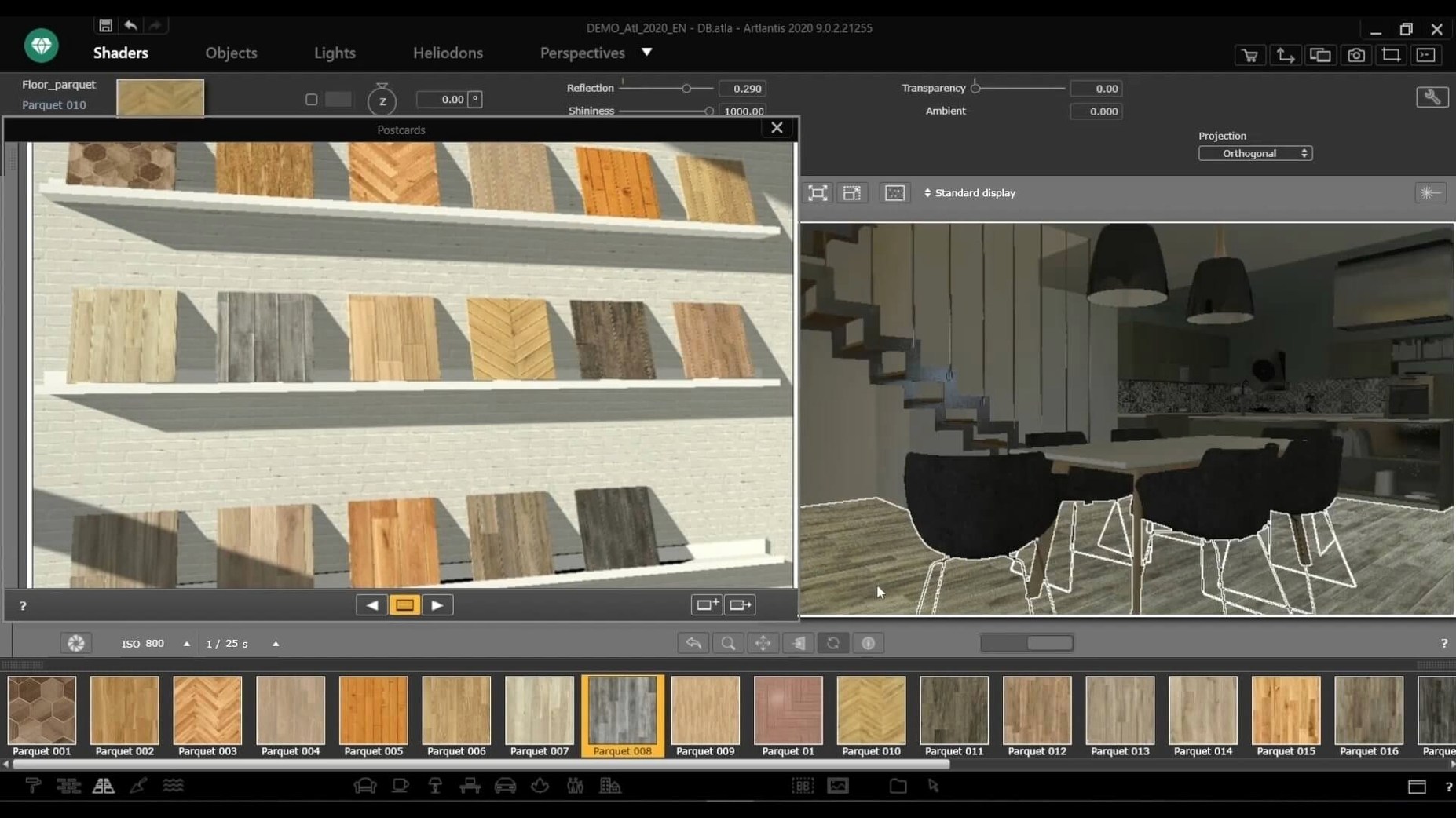
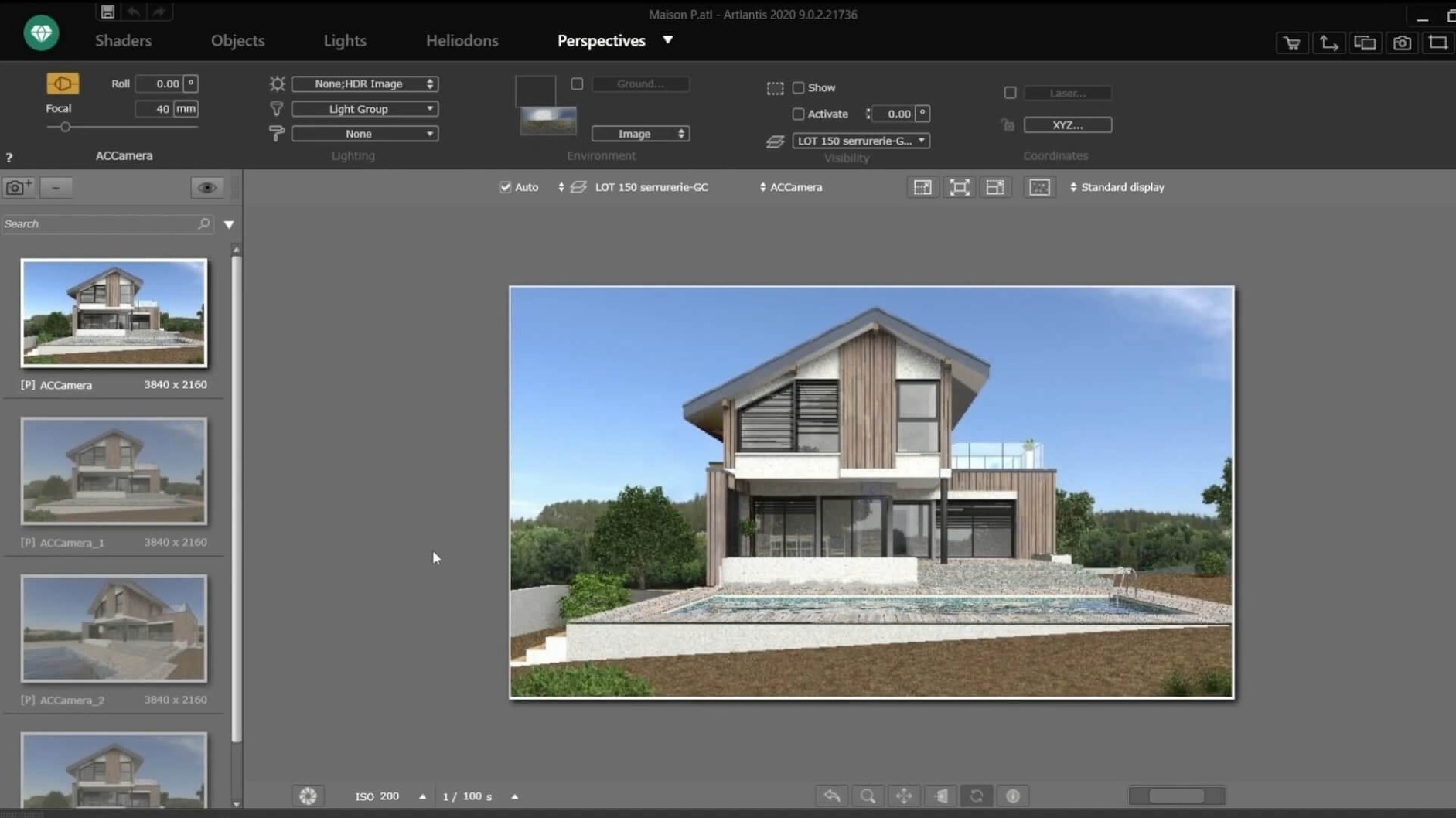
A drag-and-drop material catalog saves you from hunting through folders just to see how granite looks on that countertop. Artlantis is built for exactly that kind of direct, visual decision-making. You pull a texture from the collection, drop it on a surface, and the scene updates so you can judge the light and reflections right away.
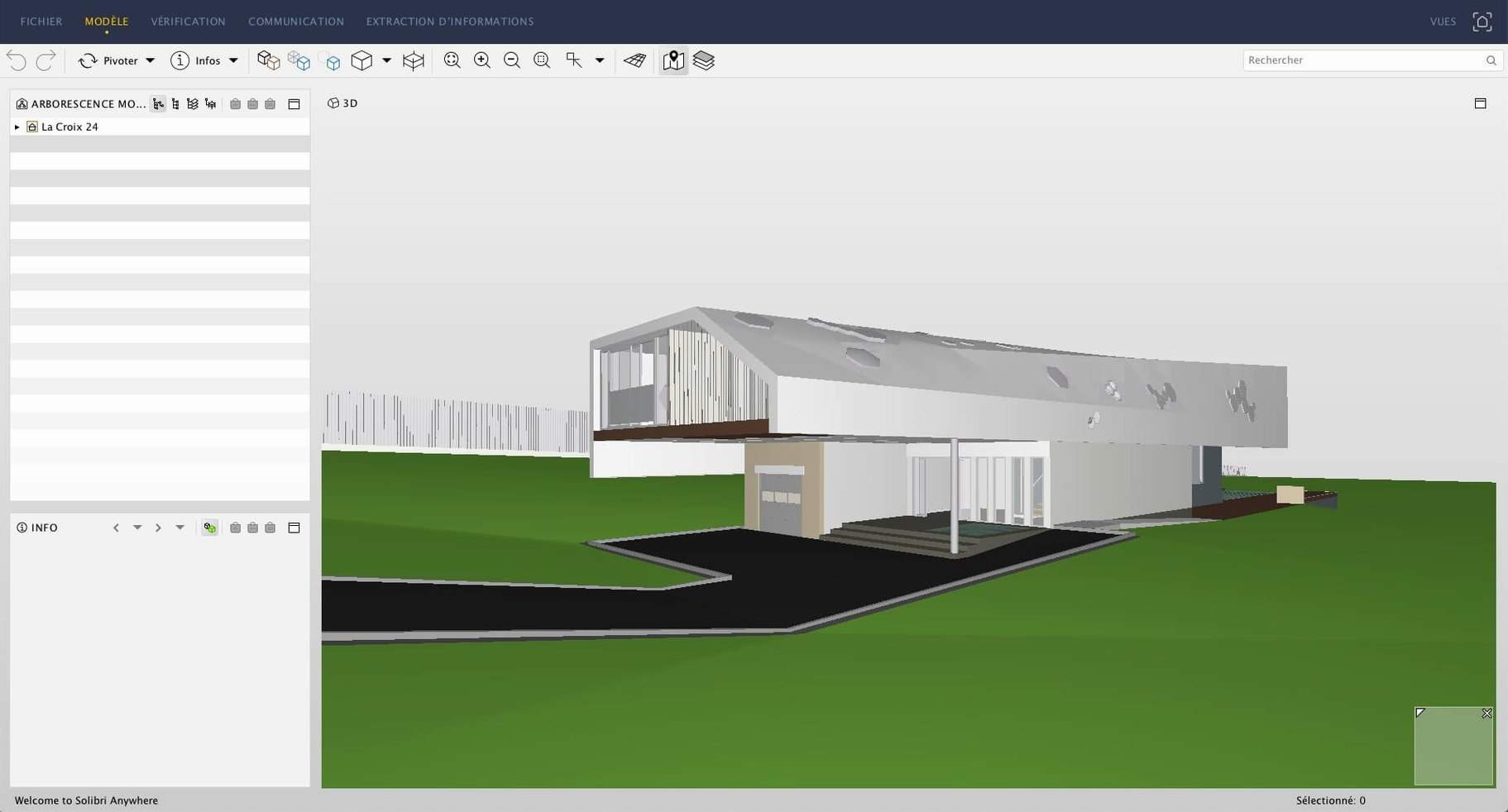
People ask about compatibility before they clear drive space, and that is the smart order of things. The app exchanges data straight with ArchiCAD, VectorWorks, SketchUp, AutoCAD, and Arc+. It also imports DXF, DWG, and 3DS files, so most CAD and modeling pipelines connect without a detour through another converter.
Once the geometry is in, you are not stuck with a flat export. You can edit motion paths for animation videos, build VR panoramas, or create a QuickTime VR file someone can spin around on their own machine. The built-in post-processing tools—brightness, contrast, color tables—let you dial in the final look without leaving the workspace.
Bottom line: it is a rendering workhorse for architects and designers who already have a model and need to show it with natural light, believable materials, and the option to hand over a walkthrough instead of a stack of stills.
Working with what you already use
Most of the time Artlantis is not where a project starts — it is where the model gets dressed up and shown off. The direct exchange with ArchiCAD and VectorWorks is the part worth setting up carefully, because it keeps materials and camera positions alive between apps. SketchUp users tend to bring in a model with basic colors, then replace them with proper shaders once the scene is lit. That two-step habit keeps the modeling side fast and the rendering side believable.
If a client sends a DXF or a 3DS file from some other program, the import usually gets you into a working scene without a full rebuild. You may need to reassign a few textures, but the geometry itself generally holds up.
On the macOS side, Artlantis plays fine with standard window management and Spaces. Keep the shader editor on one desktop and the preview window on another, and you can tweak a texture while the render redraws in front of you.
Drag an image onto any surface
- Drag an image from Finder straight onto a surface — it becomes a material without opening the catalog first.
- Use your own photos as textures. A brick wall you shot on a site visit looks more honest than the stock version.
- Save a perspective you like before you start changing lights, so you can jump back to it with one click instead of re-framing.
- Double-check the post-processing tab before you export. A gentle contrast adjustment there often beats re-rendering.
- For a quick VR panorama, set the camera at eye height and render a single frame — no need to build a full animation.
If you are looking for an artlantis 2021 download, keep in mind that the version number is not the whole story. The current build is 9.5.2.32853, and it still runs on Intel Macs going back to macOS 10.13. Some folks hunt for an Artlantis Mac torrent and find that checking the build number against your macOS version beforehand helps everything launch smoothly. Whatever route you take, the render engine is the same reliable tool, and it does not need a brand-new machine to produce a clean still or a smooth walkthrough.
- macOS 10.13 or newer
- Intel processor
Questions I actually get
Does Artlantis still work with a perpetual licence I bought years ago?
Yes, users can continue using their existing perpetual licences.
Can I build an entire VR scene without buying extra plugins?
The app includes the tools to create virtual reality scenes and export QuickTime VR files using its own material collection and post-processing features.
Notes from the tables 0
Sign in or pull up a chair to leave a note.
No notes on this one yet. They go up after I read them.
More from the Mac Apps page
The whole page Mac Apps 5.1 GB
Araxis Merge
2026.1
Mac Apps 5.1 GB
Araxis Merge
2026.1
 Mac Apps 87 MB
Apple Remote Desktop
3.10
Mac Apps 87 MB
Apple Remote Desktop
3.10
 Mac Apps Updated 16 MB
Apple Keynote
15.3.1
Mac Apps Updated 16 MB
Apple Keynote
15.3.1
 Mac Apps 356 MB
ApolloOne
4.5.0
Mac Apps 356 MB
ApolloOne
4.5.0
 Mac Apps 35 MB
AnyTrans for iOS
8.9.14
Mac Apps 35 MB
AnyTrans for iOS
8.9.14
 Mac Apps 398 MB
Antivirus Zap - Virus Scanner
3.22.0
Mac Apps 398 MB
Antivirus Zap - Virus Scanner
3.22.0
 Mac Apps Updated 49 MB
Astro Gold
6.2.1
Mac Apps Updated 49 MB
Astro Gold
6.2.1
 Mac Apps 58 MB