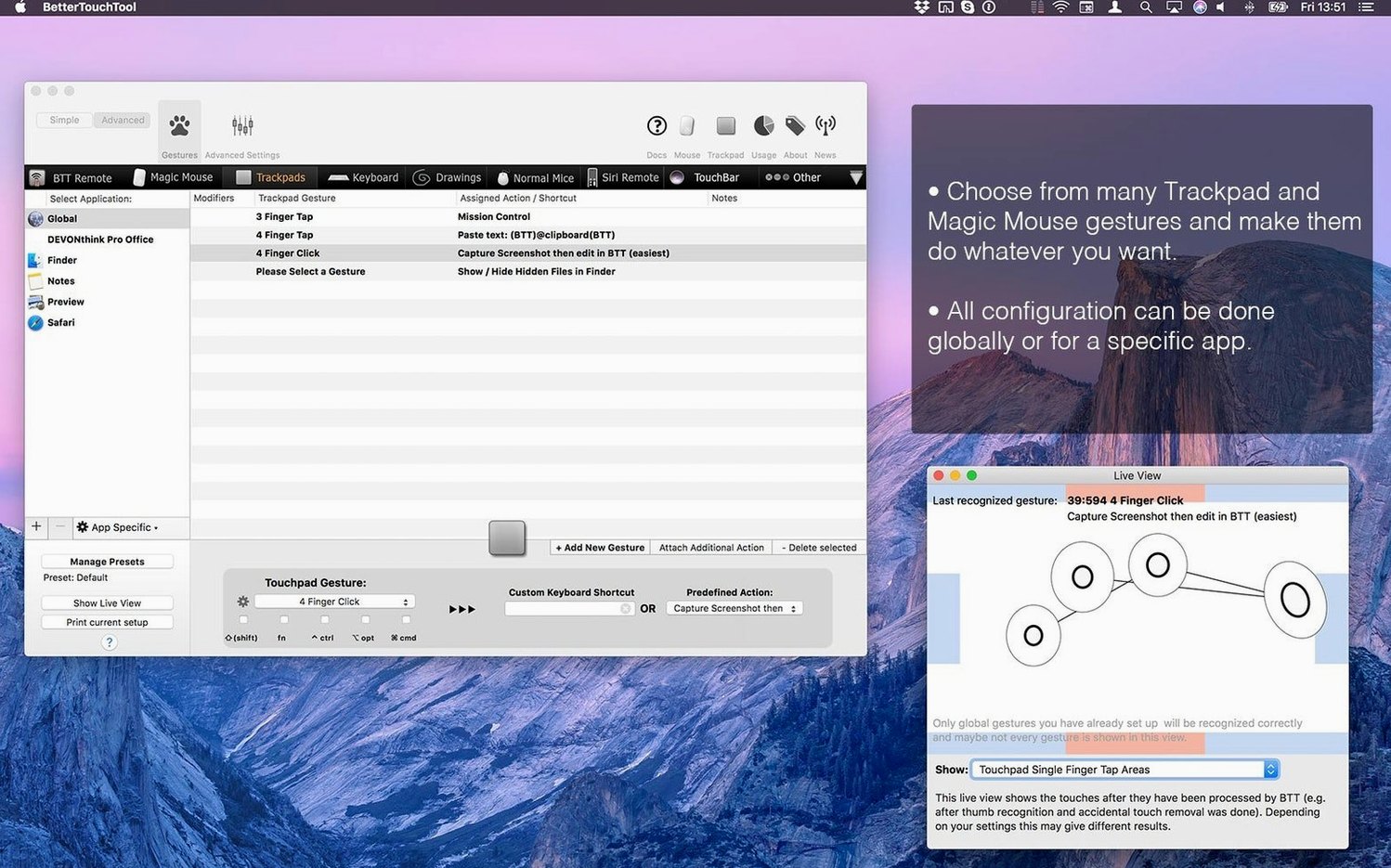
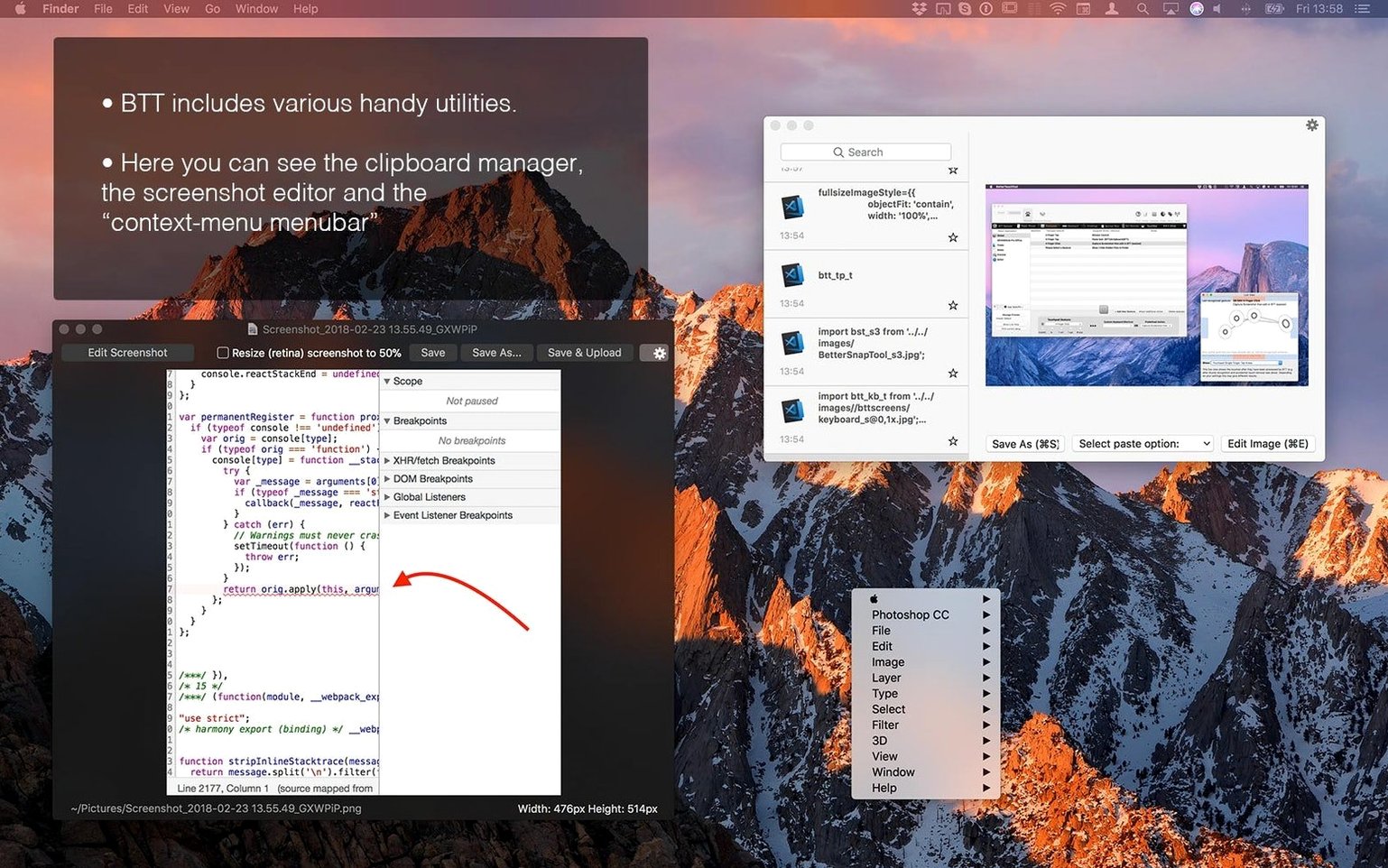
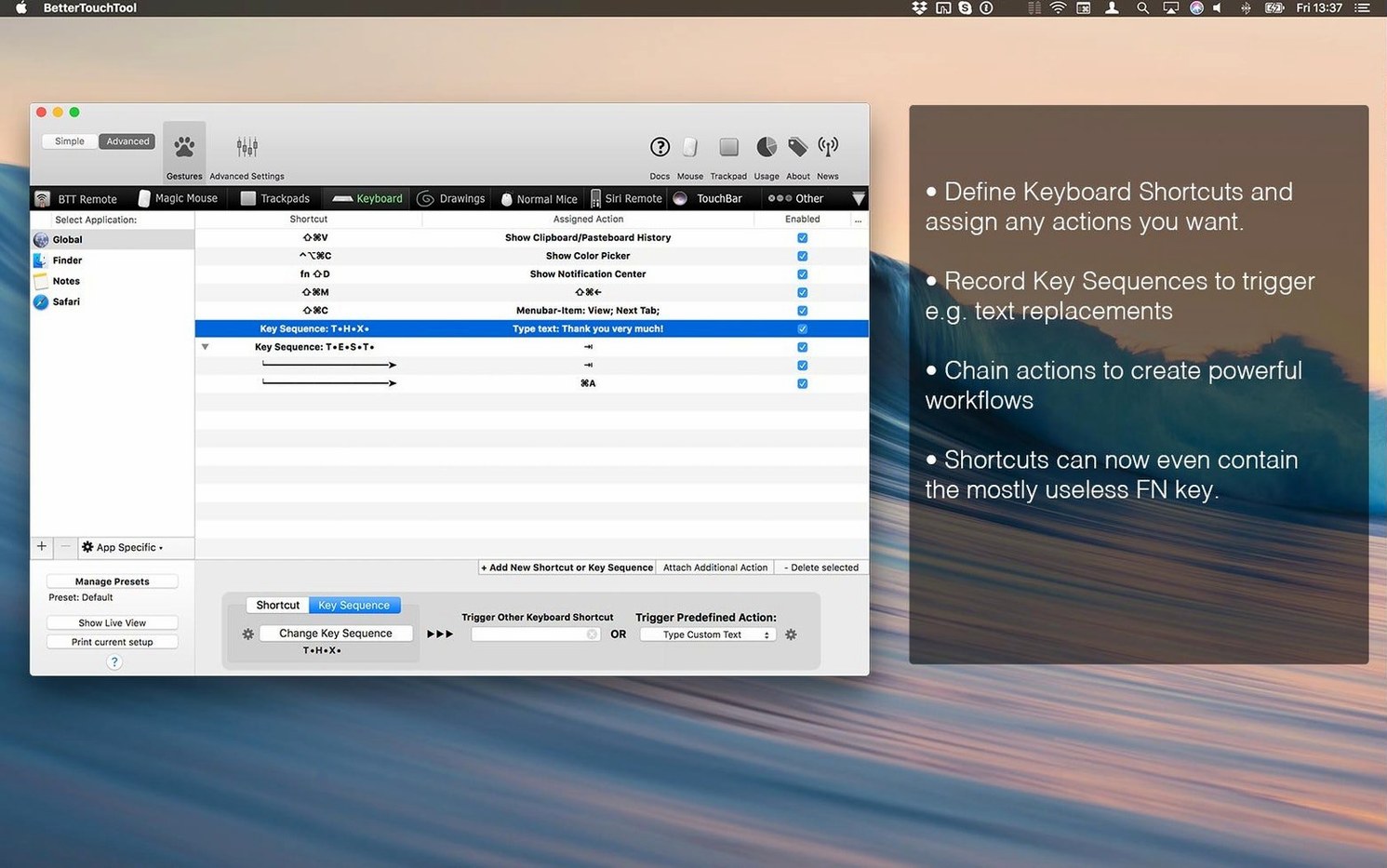
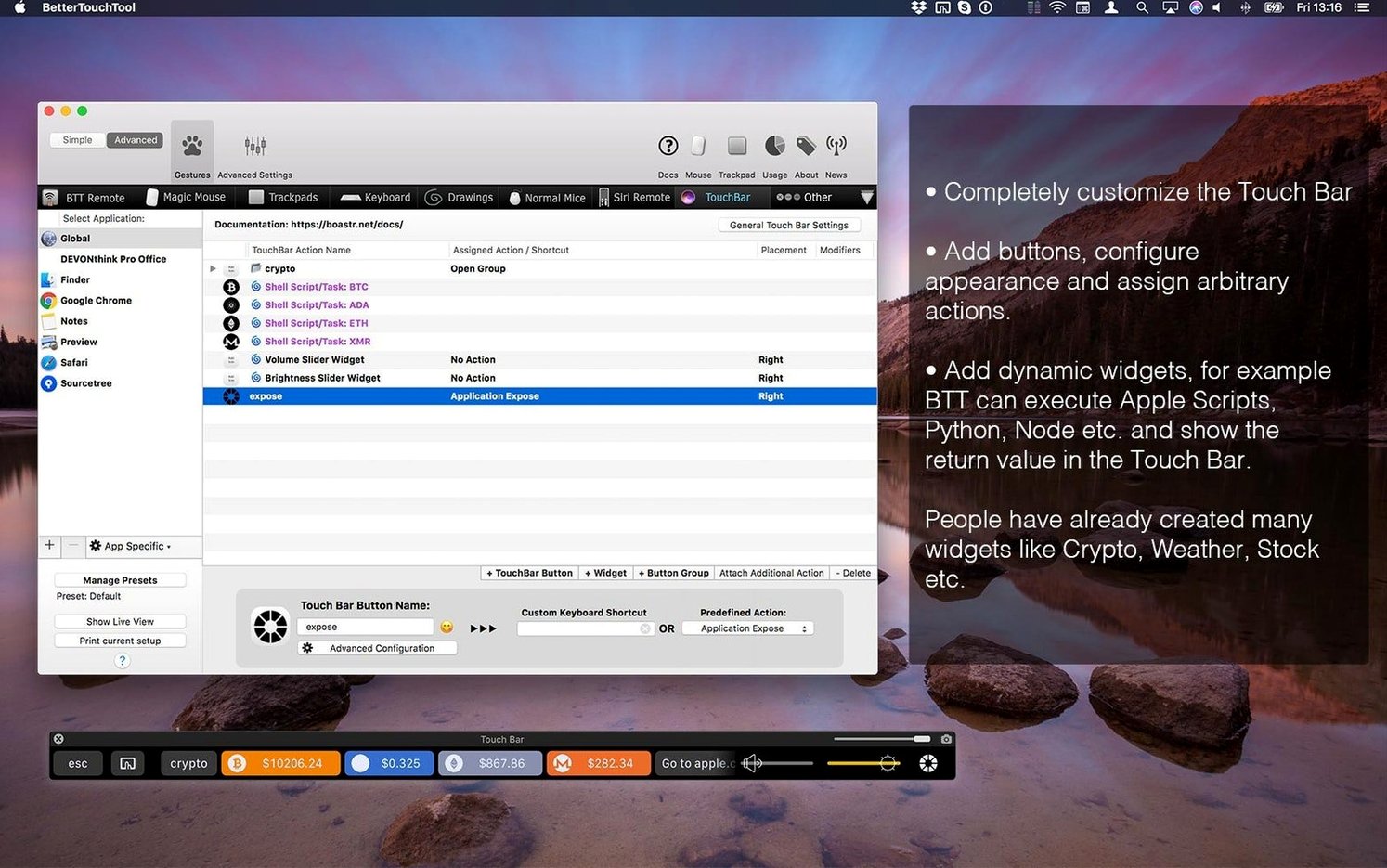
Version 6.726 still supports over a dozen distinct input methods. You can draw a shape on your trackpad to trigger an AppleScript, assign a three-finger click to open a specific folder, or turn your Siri Remote into a presentation clicker. The built-in screenshot tool now lets you annotate and crop an image the moment you capture it, and the clipboard manager quietly holds multiple copied items so nothing gets lost between tasks. If you ever wanted to build your own Touch Bar widgets that launch custom URL schemes or fire off HTTP requests, the tools are all here and unchanged. What’s new in this release is mainly under-the-hood stability work—the sort of maintenance that keeps a seventeen-year-old utility feeling reliable on modern Apple Silicon machines without rewriting the playbook.
| What | Details |
|---|---|
| Current version | 6.726 |
| macOS | 10.15 or later |
| Architecture | Apple Silicon & Intel |
| Language | English |
The core promise hasn't budged: one preference pane that gives you fine-grained control over every input device connected to your Mac. It can feel like a lot at first glance, but the reward is a setup that works exactly the way your hands expect it to.
Setting up a three-finger snap in my routine
Let me walk you through what actually happens when you sit down with BetterTouchTool for the first time after a fresh install. I'll use my own routine as an example—setting up a three-finger swipe to snap a window to the left half of the screen, but only inside Safari.
You open the app and land in the main configuration window. The left sidebar lists every input device category: trackpad, keyboard, mouse, Touch Bar, and so on. It's a lot of rows, but you don't need all of them. I click Trackpad, then hit the plus button to add a new gesture. A popup appears with a blank canvas and a dropdown that says "Trigger." I pick Three Finger Swipe Left—the app watches my trackpad for a second and confirms the gesture is recognized.
Next I choose what happens. The action picker has categories like window management, system controls, and custom scripts. I scroll to Maximize Window to Left Half and select it. Now comes the part that makes BetterTouchTool genuinely useful: under the action, there's a field labeled App-Specific. I type Safari and pick it from the autocomplete list. This gesture now only fires when Safari is the frontmost app. Everywhere else, three-finger-swipe-left does whatever macOS normally does—or nothing at all.
I test it immediately. A quick swipe and Safari's window snaps left. I open Finder, try the same gesture, and nothing happens. That's exactly what I wanted. The whole process took under ninety seconds, and I didn't touch a terminal or write a single line of code.
From there, a session usually snowballs. You fix one annoyance, then notice three more. Maybe you add a two-finger force-click on the Magic Mouse to open Terminal, or draw a tiny circle on the trackpad to mute your microphone during calls. The clipboard manager sits in the menu bar the whole time, quietly collecting everything you copy. You pull up the screenshot tool with a custom shortcut, draw an arrow on the capture, and it's saved before you can reach for Preview. That's the rhythm: configure, test, tweak, then forget the app is even there because everything just works the way your hands expect.
Karabiner-Elements vs. Keyboard Maestro vs. Swish overlap
Three names come up whenever someone asks for alternatives: Karabiner-Elements, Keyboard Maestro, and Swish. They overlap with BetterTouchTool in different ways, and which one fits depends entirely on what you're trying to customize.
Karabiner-Elements is a laser-focused keyboard remapper. If you want to turn your Caps Lock key into a Hyper key or swap the tilde with the escape key, Karabiner is excellent. It dives deeper into keyboard firmware-level remapping than BetterTouchTool ever attempts. What Karabiner doesn't do is gestures, Touch Bar widgets, clipboard management, or window snapping. It lives in keyboard land and stays there. BetterTouchTool covers all of that plus keyboard shortcuts, though its key-remapping doesn't go as deep. The two can run side by side if you're careful about conflicts.
Keyboard Maestro is the heavyweight automation engine. Its macro system can chain together dozens of actions—run scripts, manipulate windows, watch for triggers like time-of-day or Wi-Fi network changes. It does clipboard history and image manipulation too. Where BetterTouchTool wins is the input layer: Keyboard Maestro's gesture support is basic compared to drawing shapes on a trackpad or assigning five-finger swipes. Many people run both, using Keyboard Maestro for complex automation sequences and BetterTouchTool for the physical input that fires them.
Swish takes the opposite approach—it does one thing beautifully. Two-finger swipes and pinches on the trackpad control window positions with fluid animations. It feels native to macOS in a way BetterTouchTool's window-snapping doesn't, because Swish was built for that single purpose. But Swish stops at window management. No keyboard shortcuts, no Touch Bar, no mouse gestures, no clipboard. If window tiling is all you need, Swish is elegant. If you want one utility that handles all your input devices, BetterTouchTool is the broader tool.
Accidentally breaking Mission Control with a swipe
I made most of these myself, so no judgment here. The first mistake is assigning gestures that conflict with system defaults. You assign a four-finger swipe-up to something clever, then discover you can no longer trigger Mission Control. BetterTouchTool can override macOS gestures, but it doesn't warn you loudly enough. Before building a custom gesture, check what the system already uses that gesture for. A quick visit to System Settings > Trackpad shows the default mappings.
The second mistake is going too wide, too fast. On day one, it's tempting to configure twenty gestures across six apps. By day three, you can't remember what anything does, and you're accidentally triggering actions you forgot you created. Start with two or three gestures or shortcuts for the apps you use most. Live with them for a week. The muscle memory needs time to settle before you add more layers.
The third is ignoring the app-specific field. A global three-finger tap that opens your downloads folder might seem handy until it fires while you're editing video or playing a game. Tying triggers to specific applications—or excluding them from specific applications—is the difference between a setup that helps and one that constantly gets in the way. The exclusions list, tucked under the same menu, is just as important as the assignments themselves.
Lastly, beginners sometimes skip the built-in backup option. You can export your entire configuration as a single preset file. After spending hours dialing in
Version 6.726 is a maintenance update focused on stability and compatibility. No new headline features this time—just the kind of quiet polish that keeps everything running smoothly on current macOS releases and Apple Silicon hardware.
- macOS 10.15 or later
- Apple Silicon or Intel processor
Questions I actually get
Can I create my own Touch Bar buttons with BetterTouchTool?
Yes, you can build custom Touch Bar widgets that run AppleScripts, open URLs, or send HTTP requests.
Does BetterTouchTool work with a standard mouse?
Absolutely. It supports custom gestures and button actions for normal mice, Magic Mouse, and trackpads.
Is there a clipboard manager included?
Yes, a built-in clipboard manager keeps a history of multiple copied items for quick access.
Notes from the tables 0
Sign in or pull up a chair to leave a note.
No notes on this one yet. They go up after I read them.