
You'll need a Mac running OS X 10.7 or newer—it works on both Intel and Apple Silicon machines.
Tools that do real work
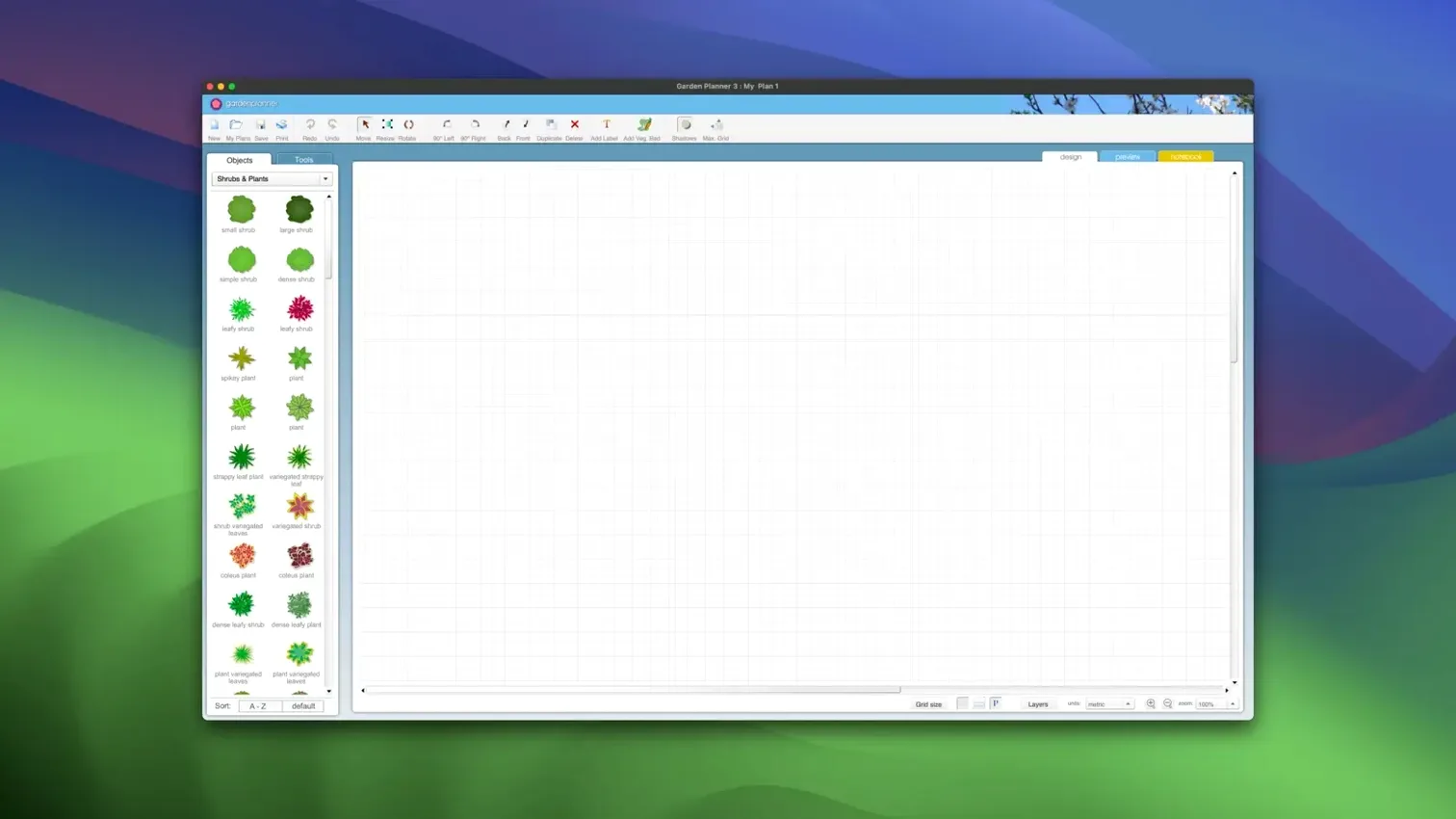
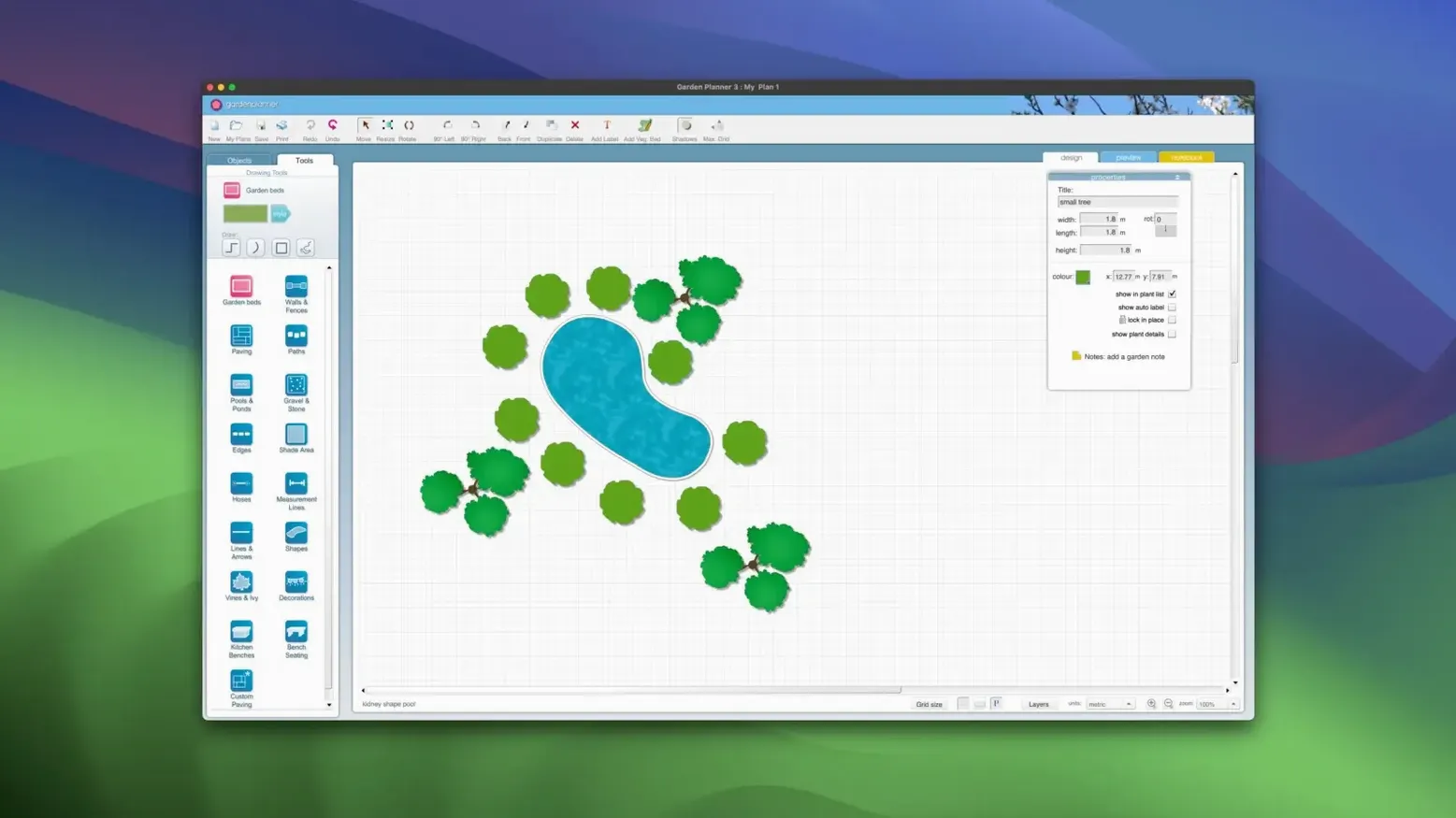
Every button in the toolbar corresponds to something you'd actually build in a yard. Here's where it shines:
- Hardscape drawing. Plot paths, paving, walkways, walls, and fences with a few clicks. Version 3.8.86 added fresh path styles, so your flagstone doesn't look like your neighbor's.
- Water features. Drag out a pool or a pond shape, then tweak the size and contour until it fits the spot beside the deck.
- Plant library. More than 1,200 plants and objects live in the sidebar, each with user-defined settings you can adjust and save for next time.
- Object handling. Rotate, duplicate, scale, and reshape anything you place—useful when the tree symbol needs to match the actual shade footprint.
- Reporting. The object report prints, saves as CSV, or exports as TXT. Handy for a trip to the nursery.
- Print and preview. High-quality printing backed by a full preview screen so you approve the layout before the ink hits.
What happens when you're done
You step back, check the preview, and print or export your plan. The report lists every evergreen and slab, and the print comes out crisp enough to hand to a contractor. Bottom line: you design the garden; the app handles the math and materials list.
Stays closest to pencil and paper, just faster
The Mac has a handful of landscape design apps, and they pull in different directions. Garden Planner stays closest to the paper-and-pencil tradition, just faster.
- Realtime Landscaping Pro. This one goes hard on 3D realism—blooming shrubs, waving grass, the works. It feels more like a video game walkthrough. Garden Planner’s 3D view gives you the spatial read without making the computer sweat, which matters on older Macs. Realtime throws in decks and gazebos; Garden Planner focuses on the living parts of the yard.
- SketchUp. Endlessly flexible and completely empty when you open it. You build everything from scratch. If you enjoy modeling a raised bed polygon by polygon, it’s unbeatable. Garden Planner hands you 1,200 plants and objects right out of the gate—less control, but you finish a layout Tuesday evening instead of Thursday.
- Punch! Home & Landscape Design. Covers the whole property, foundation to fence line. It’s heavier, broader, and arguably overkill if you only need to figure out where the hydrangeas go. Garden Planner doesn’t try to frame a garage; it sticks to soil, stone, and water.
Drop a PNG into Pages or a CSV into Numbers
Garden Planner talks to the rest of your system without ceremony. Export a PNG or JPEG and drop it into an Apple Pages document for a landscape committee submission. The CSV object report opens straight into Numbers—sort by quantity, delete the rows for plants you already own, and you've got a shopping list before you grab the car keys. Print preview leans on the standard macOS print panel, so PDF saving to a client folder is two clicks.
Since everything stays local, Spotlight finds your plan files by name as long as you save them somewhere sensible. No cloud sync to troubleshoot, no export-upload-download loop. The image exports land in Photos with a drag if you want to text a quick layout to a partner at the nursery. For hobbyists hunting down a room planner torrent to redo an indoor space, this won't scratch that itch—it's dirt and perennials, not floor plans. But some folks looking for a 5d planner crack for a patio design end up here and realize they don't need indoor 3D tricks to lay out a garden bed that works.
Version 3.8.86 rolled in some overdue love for hardscape work, plus the usual tightening-up you expect from a dot-release.
- New path styles added for more variety underfoot
- Improvements and bug fixes throughout the app
- OS X 10.7 or later
- Intel or Apple Silicon Mac (64-bit)
Questions I actually get
Can I save my own plant settings in the library?
Yes. You can apply user-defined settings to the built-in library elements so your custom heights, colors, or descriptions stick around for every project.
What formats does the object report support?
The report can be printed directly, saved as a CSV file, or exported as plain TXT.
Does it run on Apple Silicon Macs?
Yes, version 3.8.86 supports both ARM and x86 64-bit architectures, so it runs natively on newer Macs.
Notes from the tables 0
Sign in or pull up a chair to leave a note.
No notes on this one yet. They go up after I read them.