
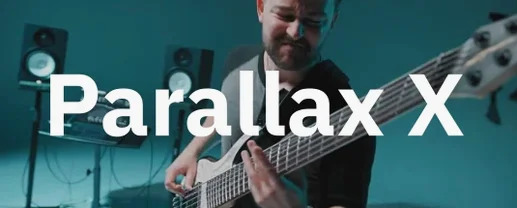
Transpose, tuner, and metronome join the rack
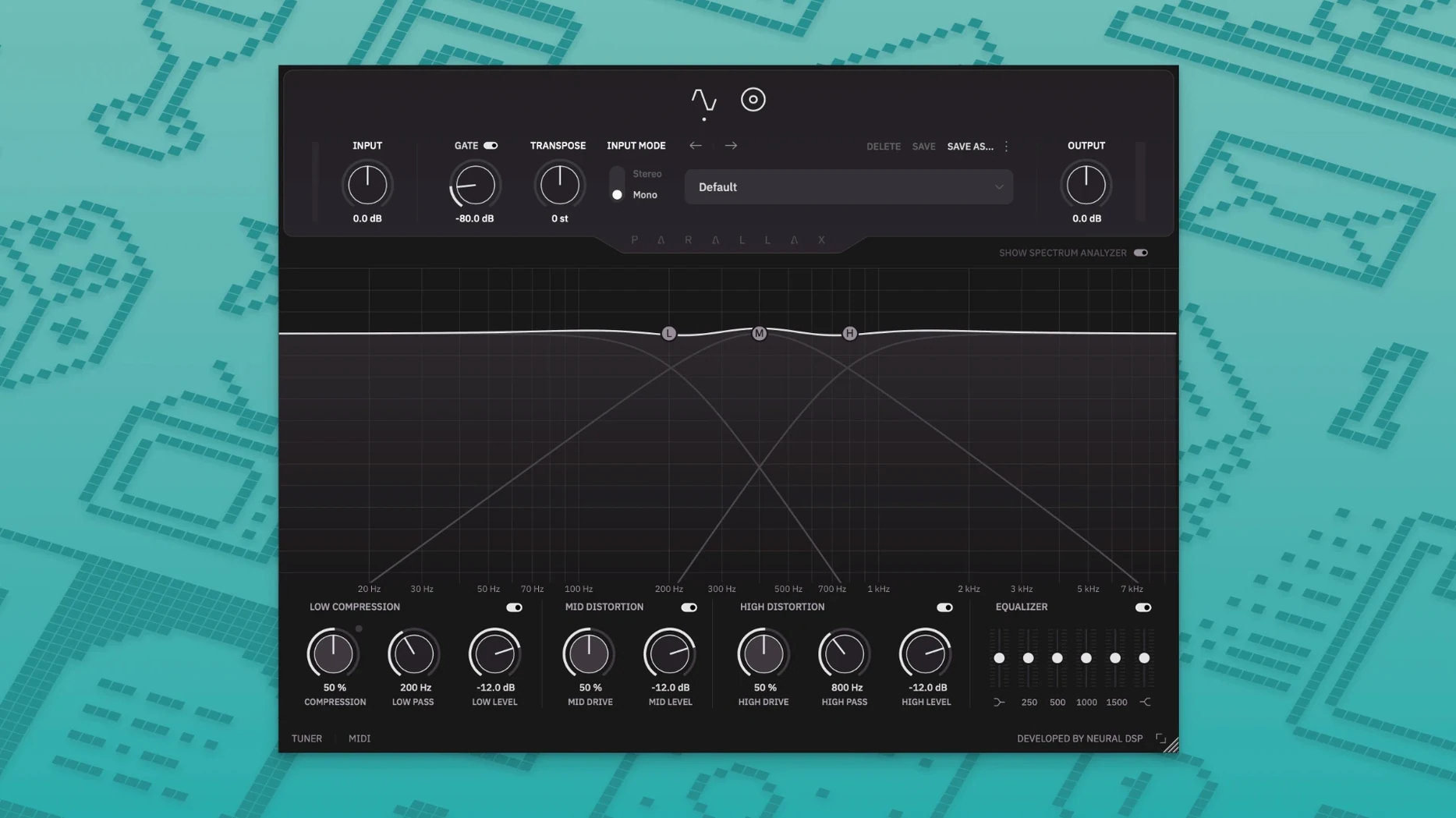
This isn't just a fresh coat of paint. Parallax X adds a Transpose knob, a live tuner, and a metronome — three utility tools that make it more of a self-contained recording partner. You also get a redesigned spectrum analyzer that's actually readable at a glance, plus a new batch of factory presets to start from.
Mid-range drive pulls out note attack
- Dialing in note articulation. The mid-range distortion control works like a tube circuit getting pushed harder. It doesn't just fuzz things up — it pulls out the attack of each note so your lines don't disappear under the guitars.
- Keeping the low end clean. Because the processing is parallel, the subs stay intact while the mid and high bands get all the growl and grit. The cabinet emulation only hits those upper bands, so your fundamental stays punchy.
- Quick pitch shifts. The transpose range covers a full octave up or down. Handy when a track's tuned a half-step away from what you already recorded.
Tube modeling splits distortion by band
- This installs as a separate plugin — your old Parallax sessions stay exactly as you left them.
- The tube-modeling approach treats the mid and high bands independently, so you're not shaping one broad distortion curve across the whole signal.
Built-in tuner cuts session setup time
The live tuner is the quiet hero here. Before version 1.0.0, you'd have another plugin open just to check tuning between takes. Now it's right there — click it, pluck a string, move on. Saves about fifteen seconds per session, which adds up when you're tracking a whole EP.
The transpose knob changed how I prep demo files. I used to re-track when a guitarist sent something in D standard while my bass was set up for E. Now I click down a whole step and play along. It's not the same as a real down-tuned instrument — you lose a little string noise and finger attack — but for writing and arranging, it's more than enough.
The metronome in standalone mode got smarter too. You can set time signature, accent pattern, and note length. I've been using it for practice runs where a click with an eighth-note subdivision helps lock in fast triplet lines. Small thing, but it means I close fewer windows before the song even starts.
Old presets carry over automatically
Will it mess up my old Parallax presets? No. The installer pulls your legacy user presets into the Parallax X folder automatically, and the original plugin stays right where it was. You can open an old session from two years ago and nothing breaks.
Does the transpose feature sound natural for recording? For demos and practice, absolutely. For a final take, I'd still tune the instrument. Pitching a whole octave up gets a little synthetic — you hear it in the high mids — but within a few semitones it's clean enough to fool a bandmate.
What's the difference between mid and treble distortion here? The design splits the signal three ways. Mid distortion adds articulation so your fingers sound more deliberate. Treble distortion adds fuzz and edge — think of it like an overdrive pedal that only touches the string clank and fret noise. You can run one without the other, or blend both for a sound that cuts through dense mixes.
Standalone mode with tuner-first workflow
I open the standalone version on a Tuesday evening, bass plugged straight into the interface. First thing: I hit the tuner. Low B is a little flat — common on a five-string — and I fix it in about ten seconds.
I pull up a preset called something straightforward like "Clean Punch" and let the low compressor do its job. The subs sit tight without any manual tweaking. I switch on the mid distortion at about nine o'clock — just enough to hear the attack on each sixteenth note. The treble band stays off for now; this line doesn't need fizz.
The cabinet section is set to a dynamic mic, close-miked. I flip through two other virtual mics — a ribbon for warmth, then back to the dynamic for definition — and land on a blend that makes the upper harmonics sit nicely without clashing with the kick drum I'll add later in the DAW. The graphic EQ gets a small cut around 400 Hz to scoop out some boxiness.
Finally, I turn on the metronome at 110 bpm with an eighth-note subdivision and run the verse four times. Each pass feels tighter. By the fourth take, I'm not watching the click — I'm inside the groove. That's when I know the preset is right and the plugin did its job without me thinking about it.
Version 1.0.0 is a proper step forward, not a tweak. The big additions are a Transpose control, a built-in live tuner, and a simple metronome — tools that turn the plugin into more of a practice and recording hub. The spectrum analyzer got a full redesign so it's easier to read while you're dialing in tones, and there's a fresh set of factory presets to jump into.
- macOS 11 or later
- 64-bit host
- Works on Intel and Apple Silicon Macs
Questions I actually get
Does Parallax X replace the original Parallax plugin?
No, it installs as a separate plugin so both versions can live on your system without overwriting older sessions.
Does it work natively on Apple Silicon Macs?
Yes, version 1.0.0 supports Native Apple Silicon and runs on macOS 11 or later as a 64-bit plugin.
Notes from the tables 0
Sign in or pull up a chair to leave a note.
No notes on this one yet. They go up after I read them.
More from the VST Plugins page
The whole page VST Plugins 441 MB
Neural DSP Soldano SLO-100 X
1.0.0
VST Plugins 441 MB
Neural DSP Soldano SLO-100 X
1.0.0
 VST Plugins 340 MB
Neural DSP Archetype Rabea X
1.0.1
VST Plugins 340 MB
Neural DSP Archetype Rabea X
1.0.1
 VST Plugins 742 MB
Neural DSP Archetype Petrucci
1.0.0
VST Plugins 742 MB
Neural DSP Archetype Petrucci
1.0.0
 VST Plugins 745 MB
Neural DSP Archetype John Mayer X
1.0.0
VST Plugins 745 MB
Neural DSP Archetype John Mayer X
1.0.0
 VST Plugins 498 MB
Native Instruments Massive X
1.7.1
VST Plugins 498 MB
Native Instruments Massive X
1.7.1
 VST Plugins 1.6 GB
noteGRABBER
2.0.0
VST Plugins 1.6 GB
noteGRABBER
2.0.0
 VST Plugins 35 MB
Nudist Audio Nudistort
1.2.5
VST Plugins 35 MB
Nudist Audio Nudistort
1.2.5
 VST Plugins 45 MB