

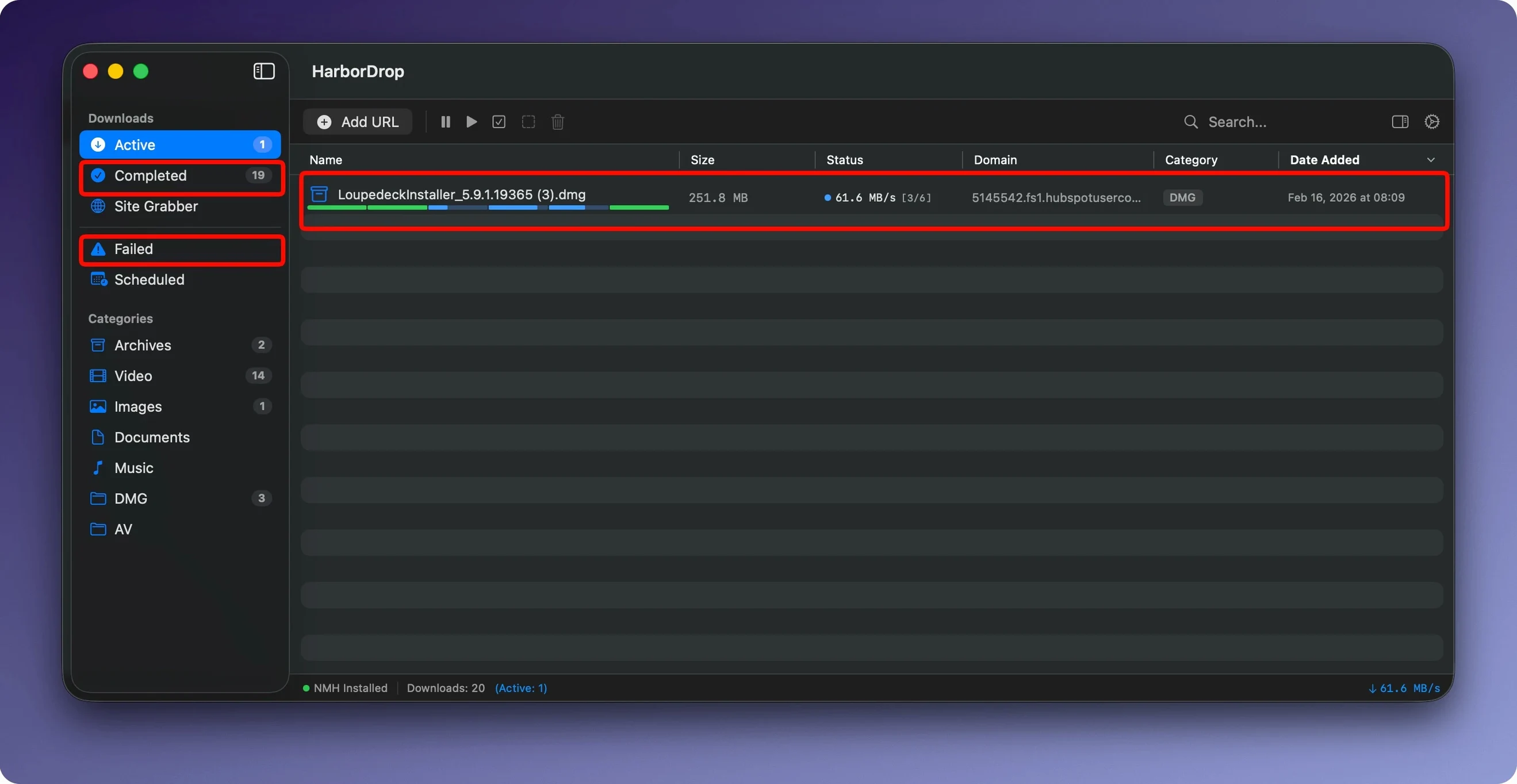
You find a large software disk image, a batch of instructional videos, and an m3u8 stream you want to save for a long flight — so you send all three to HarborDrop and walk away while it queues them up, splits them into parts, and runs a script to rename the finished files into your own folder structure.
Segmented downloading — splits files into multiple chunks and fetches them in parallel, which can shorten long waits on big transfers.
Browser integration — intercepts file links from your browsing session; an extension is available for Firefox, so clicks from supported sites land straight in the queue.
HLS and m3u8 — understands HTTP Live Streaming playlists and can grab non-DRM video from supported websites for offline viewing.
Site Grabber — collects links from a page and follows them to a crawl depth you specify; handy for pulling down a whole set of PDFs or media files in one go.
Post-download automation — can fire off a Shell script or a snippet of JavaScript once a download finishes. Use it to move files, unzip archives, or push a notification to another tool.
Finder reveal — opens the file’s folder right after the transfer completes, so you never hunt through the directory tree.
Parallel chunks beat throttled servers for large files
People who regularly grab large installer images, video courses, or ISO files notice the segmented downloading first. If your connection is fast but the server is throttling single streams, those parallel chunks earn back minutes you’d otherwise lose.
Video editors and flight-crew members who stash offline viewing material lean on the HLS and m3u8 support. It’s not a screen recorder — it pulls the media chunks directly, so the result is the original quality with no re-compression dance. Users who run a Plex server at home often pair it with the post-download AppleScript to auto-sort new arrivals into the right library folders.
People who manage batches of downloads from the same source — a course platform, a stock asset library, a long documentation site — get the most from the Site Grabber. Set the crawl depth to two or three, filter by file type, and let it work while you do something else.
Adjust parallelism per download by right‑clicking the segment count
- Right-click the segment count — you can change it per download, not just globally. Some servers hate parallelism above four chunks, so dial it down on the fly instead of digging into preferences.
- Drag a URL from the address bar — the app accepts a direct link drop onto the queue window. No need to copy, switch, and paste.
- Post-download JavaScript — this one’s easy to miss. A tiny script can tag the file with a Finder comment or write a timestamp to a log, all without touching the shell.
- Domain-based rules — sorting by site domain means everything from
example-course.comlands in one folder while atoolsdomain feeds another. Set it once in the automation panel and forget it.
Lighter than Folx, with scripting hooks that win for HLS
Compared to Folx, HarborDrop feels lighter on the extras — Folx wraps in a torrent client and a more elaborate tag system — but HarborDrop’s scripting hooks and HLS handling give it an edge when you want the download manager to feed into your own workflow rather than manage everything inside its own library. Folx is a kitchen that also bakes bread; HarborDrop is the prep station that hands ingredients to your own recipes.
Next to Neat Download Manager, the gap shows in automation. Neat is free and surprisingly capable for straight HTTP downloads, but it stops at the download. HarborDrop starts where that ends, with AppleScript, shell, and JavaScript triggers that turn a completed file into the first step of a chain.
Against JDownloader — the old workhorse — HarborDrop trades a massive plugin catalog for a native Mac feel and a cleaner browser capture. JDownloader catches more edge-case hosting sites, but HarborDrop’s lighter footprint and Finder-friendly design suit someone who lives in the Apple ecosystem and doesn’t want a Java-based tool running scripts from a community plugin folder. If you spend most of your day in Safari, Chrome, or Edge and your downloads come from a handful of trusted sources, the trade-off tilts toward HarborDrop.
One more comparison that’s implied by the name: people call it an IDM alternative, and that’s fair in spirit, but HarborDrop builds its own path with the Site Grabber and scriptable post-processing instead of chasing feature parity.
- macOS 12 or later
- Runs on Intel and Apple Silicon Macs
Notes from the tables 0
Sign in or pull up a chair to leave a note.
No notes on this one yet. They go up after I read them.
More from the Video Downloaders page
The whole page Video Downloaders 76 MB
Folx Pro
5.34
Video Downloaders 76 MB
Folx Pro
5.34
 Video Downloaders 30 MB
iTubeGo
10.15.0
Video Downloaders 30 MB
iTubeGo
10.15.0
 Video Downloaders 115 MB
Downie
4.13.1
Video Downloaders 115 MB
Downie
4.13.1
 Video Downloaders 42 MB
Musify
5.3.0
Video Downloaders 42 MB
Musify
5.3.0
 Video Downloaders 68 MB
AmpliTube
5.8.2
Video Downloaders 68 MB
AmpliTube
5.8.2
 Video Downloaders 3.1 GB
PullTube
1.8.6.41
Video Downloaders 3.1 GB
PullTube
1.8.6.41
 Video Downloaders Updated 250 MB
4K YouTube to MP3
26.3.5
Video Downloaders Updated 250 MB
4K YouTube to MP3
26.3.5
 Video Downloaders 218 MB