

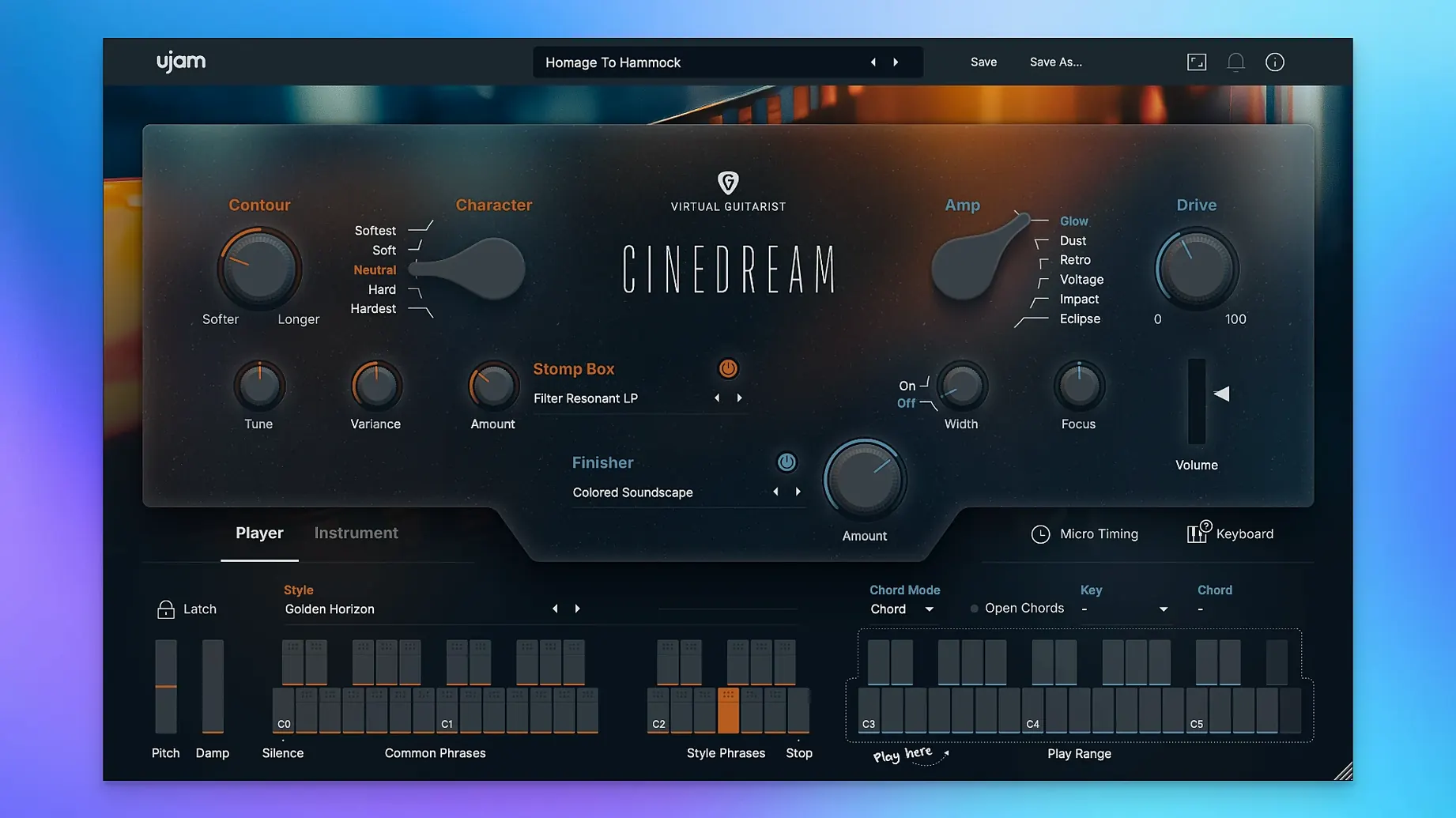
It comes as a VST, AU, or AAX plug-in, runs native on Apple Silicon and Intel Macs, and asks for macOS 10.13 or newer with a minimum of 8 GB of RAM. The interface needs at least a 1280 x 768 display to breathe, so a cramped laptop screen might feel tight.
That setup delivers a processed electric guitar that’s been completely reworked for ambient textures, not traditional riffs. You hold down a chord and the instrument evolves it on its own — soft swells, slow attacks, background movement that sits behind a scene instead of stepping in front of it.
The ready-made styles are the quickest way in. Pick a mood, play a chord, and the engine handles the pacing. From there, the built-in effects let you push things further into space and motion without leaving the plug-in window. It’s designed for emotional cues, drone beds, and the kind of parts that a viewer feels rather than notices.
who clicks with cinedream fastest
Film composers working against a deadline tend to bond with it in the first ten minutes. They need a bed of texture under dialogue, something with motion but no sharp attacks, and the style presets deliver exactly that without scrolling through fifty patches named after galaxies. Electronic producers building ambient intros get similar mileage — drop a minor chord, let the engine do the slow evolution, and suddenly the track has an emotional center without a single manual automation lane. Sound designers looking for source material to mangle further also find it useful; the dry-through-saturated range gives them plenty to resample.
People coming from traditional guitar sample libraries sometimes need a moment to adjust. Cinedream isn't about realism or articulation switching — it's about mood. If you accept that early, you'll work fast.
Dense chord stacks turn to mush
The most common mistake is playing too much. This instrument thrives on space. Beginners often treat it like a keyboard pad and stack dense four-note voicings one after another, then wonder why the mix turns to mush. A single sustained chord with an open fifth and a ninth gives the engine more room to breathe than a full jazz voicing ever will.
Another misstep is ignoring the effects section entirely and reaching straight for third-party reverb. The built-in ambience controls are tuned to the source material; dialing them in first, then adding external processing only if needed, usually saves time and CPU. Some users also overlook the gain-staging sweet spot — pushing the saturation too hard before the chord has a chance to bloom robs the texture of its shape.
Finally, skipping the manual's note about the chord trigger system leads to confusion when a held triad suddenly shifts into a completely different inversion. The engine interprets certain voicings as cues for movement; understanding that relationship turns a guess into a choice.
DAW-only, no standalone mode
Does it work as a standalone app, or only inside a DAW? Cinedream is a plug-in only — VST2, VST3, AU2, and AAX formats. You need a host like Logic Pro, Ableton Live, Pro Tools, or similar. There's no standalone player, so budget for a compatible DAW if you don't already run one.
How much disk space does the sample content actually take? UJAM specifies 4 GB of free space, and that covers the core library. The installer places data in a shared UJAM folder under /Library/Application Support/UJAM/VG-CINEDREAM, plus user-level presets and component files. If you're tight on space, know that the content isn't streamed — it sits on your drive.
Will it kill my older Intel machine? It runs on anything from macOS 10.13 forward, with native Apple Silicon support and full Intel compatibility. A 2015 MacBook Pro with 8 GB of RAM handles a few instances without complaint, though complex sessions with multiple cinematic plug-ins will eventually ask for more headroom. The 1280 x 768 minimum resolution is modest; most screens clear that easily.
Can I use it for genres outside film scoring and ambient? Absolutely, though that's where it feels most at home. Pop producers occasionally sneak it into bridge sections for contrast, and lo-fi beatmakers find the saturated textures sit nicely behind chopped samples. Just know the attack is deliberately slow — this won't replace a staccato guitar library.
Part of UJAM’s Virtual Guitarist series, Cinedream doesn’t try to be a do-everything guitar. It’s a shortcut to a specific, cinematic sound.
- macOS 10.13 or later
- Apple Silicon or Intel processor
- 8 GB RAM
- 4 GB free disk space
- 1280 x 768 minimum display
- Internet connection
Questions I actually get
Does Cinedream work on Apple Silicon Macs?
Yes, it runs natively on both ARM and 64-bit x86 architectures, so Apple Silicon and Intel Macs are fully supported.
What kind of sound does Cinedream produce?
It uses a real guitar that has been processed for cinematic music and sound design, giving you soft pads, evolving textures, and emotional background parts.
Notes from the tables 0
Sign in or pull up a chair to leave a note.
No notes on this one yet. They go up after I read them.
More from the VST Plugins page
The whole page VST Plugins 262 MB
UJAM Symphonic Elements STRIIIINGS
1.3.1
VST Plugins 262 MB
UJAM Symphonic Elements STRIIIINGS
1.3.1
 VST Plugins 4.4 GB
Ultra Audio Ultra
1.1.4
VST Plugins 4.4 GB
Ultra Audio Ultra
1.1.4
 VST Plugins 293 MB
UnderTone Audio UnFairchild
1.0.8
VST Plugins 293 MB
UnderTone Audio UnFairchild
1.0.8
 VST Plugins 220 MB
Valhalla DSP Bundle
2025.12
VST Plugins 220 MB
Valhalla DSP Bundle
2025.12
 VST Plugins 61 MB
VocalNet
1.0.4
VST Plugins 61 MB
VocalNet
1.0.4
 VST Plugins 669 MB
VocalSynth 2
2.6.1
VST Plugins 669 MB
VocalSynth 2
2.6.1
 VST Plugins 259 MB
Toontrack EZmix Bundle
3.2.2
VST Plugins 259 MB
Toontrack EZmix Bundle
3.2.2
 VST Plugins 977 MB